






Wandering across the stony hillsides of South Africa's semi-arid Karoo plateau, the first botanical marvel that commands your attention under the scorching sun is a cluster of vivid green, glistening cylindrical foliage crowned with upright spires of golden-yellow and bright orange blossoms. This resilient wonder belongs to the genus Bulbine, one of the most generous and drought-hardy members of the family Asphodelaceae. Much like its distant cousin Aloe vera, Bulbine conceals within the core of its succulent foliage a precious reservoir of water and bioactive polysaccharides. Growing a Bulbine on your windowsill or balcony is not merely a design statement; it is a daily front-row seat to evolutionary adaptation at its finest.
Many devoted succulent lovers arrive at our greenhouse asking: 'How do I cultivate and sustain a flourishing Bulbine succulent?' The answer lies in understanding the plant's cellular water-storage mechanics and subterranean root respiration. Pouring water over succulents on a rigid calendar is not an act of kindness; it suffocates and drowns root hairs. When paired with high-intensity light and an exquisitely porous, aerated mineral mix, Bulbine reveals itself as an exceptionally low-maintenance companion capable of blooming practically all year long.
1. Botanical Biology and Physiological Foundations
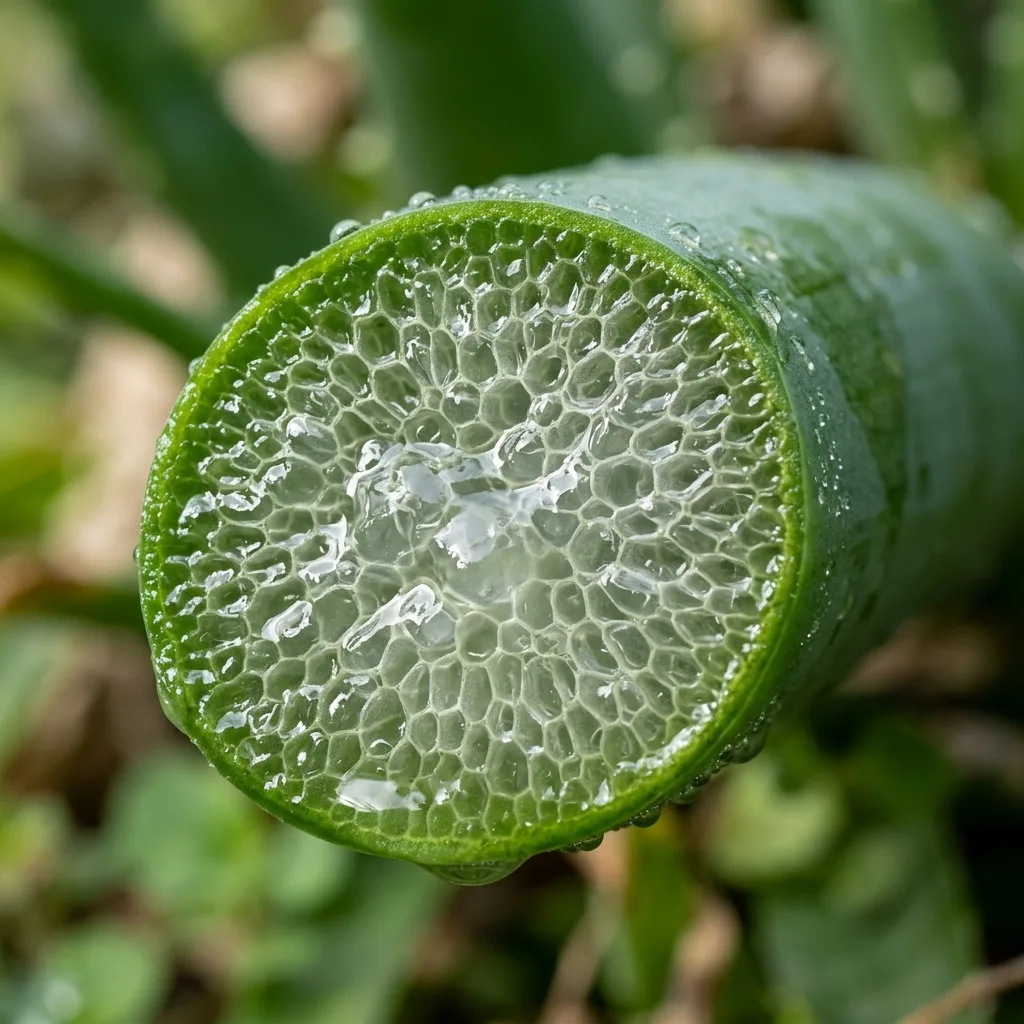
Bulbine species (most notably the widely cultivated Bulbine frutescens and the miniature caudiciform collector's specimen Bulbine mesembryanthemoides) have perfected physiological mechanisms tailored specifically to xeric habitats. Inspecting a cross-section of its foliage under a microscope reveals tightly packed water-storage parenchyma cells protected beneath a thick, waxy cuticle. These specialized cells bind moisture within a gelatinous mucilage matrix. This gel does far more than just thwart transpiration; it maintains continuous internal turgor pressure for weeks, allowing the plant to remain structurally robust through protracted seasonal droughts.
Subterraneously, Bulbine anchors itself with a specialized rhizomatous root architecture composed of both fibrous anchoring networks and semi-fleshy storage roots. While xylem vessels rapidly transport moisture upward toward stems and foliage, the root cortex possesses a critical, uncompromised demand for gaseous oxygen. When planted in water-retentive peat or dense garden loam, moisture fills all available micropores, starving root hairs of oxygen (rhizosphere anoxia) and triggering catastrophic cellular death. Opportunistic pathogens—principally Fusarium and Pythium—speedily invade, inducing fatal rhizome rot. Therefore, our primary horticultural objective is never merely wetting the soil, but maintaining an oxygenated, porous micro-ecosystem where root zones can breathe freely.
2. Accurate Diagnostics and Symptoms of Distress
Attuning your eye to the morphological language of your Bulbine is key to preventative care. The leaves and stems provide immediate visual feedback regarding environmental imbalances:
- Etiolation (Light Deprivation): The foliage sheds its vibrant apple-green luster, turning pale and chlorotic. Leaves lose their stout, cylindrical architecture, becoming spindly, weak, and unnaturally elongated as they stretch toward the nearest light source due to disrupted chlorophyll synthesis and extended internodal spacing.
- Rhizosphere Suffocation & Overwatering: Basal leaves closest to the crown turn translucent and soften into a yellowish-brown jelly-like consistency, detaching effortlessly upon contact. A faint sour odor may emanate from the damp substrate.
- Severe Dehydration: Longitudinal wrinkles and deep grooves develop along the cylindrical leaves, tips turn brittle and brown, and the entire clump halts vegetative expansion, pulling inward defensively.
- Phototoxic Scorching & Anthocyanin Flush: Moving a shade-adapted plant directly into unshielded midday sun produces silvery-white or bleached necrotic lesions on leaf surfaces. Conversely, a subtle reddish, bronze, or purple blush is a natural, protective synthesis of anthocyanin pigments and indicates healthy, high-light acclimation.
3. Step-by-Step Care Protocol
Follow this five-step clinical cultivation protocol to nurture an exceptionally vigorous, blossom-covered Bulbine with resilient root systems:
- Vessel Selection and Drainage Architecture: Bulbine expands horizontally by producing clumping basal offsets along rhizomes. Opt for wide, shallow terracotta planters equipped with generous drainage holes rather than deep, narrow vessels. The porous clay walls encourage rapid side-wall evaporation, maximizing oxygenation across the root zone.
- Formulating an Inorganic Substrate: Standard potting soils are fatal to Bulbine. Formulate a gritty, open mix composed of 40% washed horticultural pumice (3–6 mm), 20% zeolite or crushed volcanic basalt, 10% coarse horticultural silica grit, and 30% screened organic fibrous cactus peat or aged coco coir.
- Systematic Acclimation (Hardening Off): Bulbine performs best when receiving at least 5 to 6 hours of unfiltered direct sunlight daily. However, freshly acquired nursery specimens must be hardened off gradually. Position the plant in bright, indirect light for the first 10 days, subsequently advancing it into direct morning sun by one additional hour each day to thicken the protective foliar cuticle.
- Deep Saturation & Dry-Down Cycle: Discard the practice of frequent micro-dosing. When the substrate dries out, hydrate generously until water pours freely from the base drainage holes. Discard any residual runoff sitting in saucer trays after 15 minutes. Allow roughly 90% to 100% of the soil profile to dry before considering the next soaking.
- Inflorescence Maintenance and Deadheading: Throughout its active flowering windows, shear spent blossom spikes cleanly at their base using sterile bypass pruners. This simple intervention prevents superfluous seed setting, redirecting metabolic sugars toward new floral primordia and vigorous basal tillering.
4. Essential Equipment, Material Specifications, and Metrics
The operational metrics and physical inputs required to optimize vegetative expansion and metabolic balance in Bulbine are outlined in the reference table below:
| Parameter / Component | Recommended Specification | Cellular & Physiological Function |
|---|---|---|
| Substrate Porosity | 60–70% Inorganic Aggregates (Pumice/Zeolite/Lava) | Maintains macro-void air pockets to prevent rhizosphere hypoxia and root rot. |
| Substrate Organic Fraction | 30% Screened Coir / Peat Fiber | Provides cation-exchange capacity (CEC) to buffer essential ions and support mycorrhizae. |
| Light Intensity | 5,000–10,000 Lux (Direct / High Sunlight) | Drives compact habit, dense epicuticular development, and prolific raceme formation. |
| Irrigation Cadence | Complete saturation upon 100% dry substrate | Triggers deep xylem moisture uptake and encourages expansive exploratory root branching. |
| Container Medium | Unglazed, Porous Terracotta | Expels excess moisture through clay pores, balancing root zone temperature and humidity. |
| Nutrient Inputs (NPK) | Low-Nitrogen, High-Potassium (e.g., 5-10-10) | Reinforces cell wall lignification and stress tolerance without generating soft, pest-prone growth. |

5. Five Common Cultivation Pitfalls and Remediation
- Pitfall 1: Planting in undrained glass terrariums or glazed cachepots.
Remediation: Waterlogged sediments dissolve delicate succulent root hairs within 48 hours. Remove the plant immediately, excise decayed tissue, air-dry the root cluster in a warm, shaded room for 24 hours, and transfer into a porous terracotta vessel with open drainage. - Pitfall 2: Administering high-nitrogen houseplant fertilizers.
Remediation: Excessive nitrogen drives fragile, overly watery vegetative tissues that fall prey to sap-sucking pests, while floral buds abort completely. Leach the potting mix thoroughly with clean water to flush excess mineral salts, and switch exclusively to a diluted, potassium-forward cactus nutrient during peak growth. - Pitfall 3: Overhead foliage wetting during winter resting periods.
Remediation: Trapped water droplets resting within crowded foliar rosettes at lower temperatures encourage botrytis and apical necrosis. Always introduce moisture directly at soil level, keeping the leafy crown entirely dry. - Pitfall 4: Sustaining the plant in dimly lit interior hallways.
Remediation: Bulbine is an obligate sun-worshipper, not a low-light tropical understory plant. Without strong solar radiation, stems become limp and unsightly. Reposition to an unshaded southern or western exposure, or supplement with a full-spectrum 6500K horticultural grow lamp set for 12 hours daily. - Pitfall 5: Watering immediately after repotting or root pruning.
Remediation: Microscopic tears inflicted during root manipulation provide an entry portal for fungal pathogens if wet soil touches raw wounds. Keep the newly potted specimen dry for at least 4 to 6 days, allowing subterranean abrasions to suberize and develop protective callus tissue before introducing the first drink.
6. Seasonal Management Calendar and Long-Term Projections
Harmonizing your care regime with the natural seasonal cadence ensures longevity and perpetual flowering displays for decades:
- Spring (Vegetative Awakening): From March through May, roots awaken, fresh cylindrical shoots erupt from rhizomes, and the season's first floral racemes emerge. Progressively increase watering frequency and apply a half-strength, balanced succulent fertilizer once a month. This period represents the prime horticultural window for division and propagation.
- Summer (Floral Flourish and Aeration): Uninhibited sun exposure coupled with thorough watering intervals fuels brilliant blooms. During extreme heatwaves (above 38°C / 100°F), light dappled afternoon shade protects foliage against stress-induced bleaching. Provide maximum outdoor air movement to inspire uninterrupted floral succession.
- Autumn (Metabolic Tapering): As day lengths contract and evening temperatures drop, vegetative metabolism downshifts. Cease all fertilization completely and stretch irrigation intervals. Remove spent floral scapes to preserve structural vitality going into winter.
- Winter (Semi-Dormancy): While established garden specimens can briefly endure mild freezes down to -2°C (28°F), potted root systems are far more vulnerable. Relocate containers to a bright, cool indoor space (8–14°C / 46–57°F). Curtail irrigation to once a month or only when leaves begin to show visible shrinkage. Wet, chilled roots are fatal—when in doubt during winter, keep the soil dry!


Reader Reviews & Comments 3 Reviews
Eleanor Vance
Sophia Bennett
Marcus Thorne
Leave a Review & Rating
Share your plant care tips, experiences, or questions with our succulent community.