






Clinging to rocky crevices beneath the scorching sun of South Africa's semi-arid Karoo plateaus, trailing species of the genus Curio demonstrate one of nature's most mesmerizing geometry lessons. Cascading from elegant pots in our living spaces like beaded necklaces or leaping pods of tiny dolphins, these plants were historically classified under the broad genus Senecio. Today, morphological and genetic distinctions place them in their own autonomous genus, Curio. Keeping these architectural wonders plump and robust indoors depends entirely on replicating the root aeration and seasonal hydrological rhythms of their native habitat.
When indoor growers ask in frustration, 'Why are my Curio beads shriveling?' or 'Why did my plant suddenly turn to mush and collapse at the soil line?', the root issue almost always stems from misinterpreting the plant's surface-area reduction adaptations. Saturating succulents with frequent irrigation is not an act of care; it inadvertently suffocates root tissue by depleting essential pore-space oxygen. In this guide, we unpack the cellular and physiological secrets of the genus Curio, outlining the practical, evidence-based steps needed to cultivate vigorously trailing stems that flourish for decades.
1. Botanical Biology and Physiological Foundations
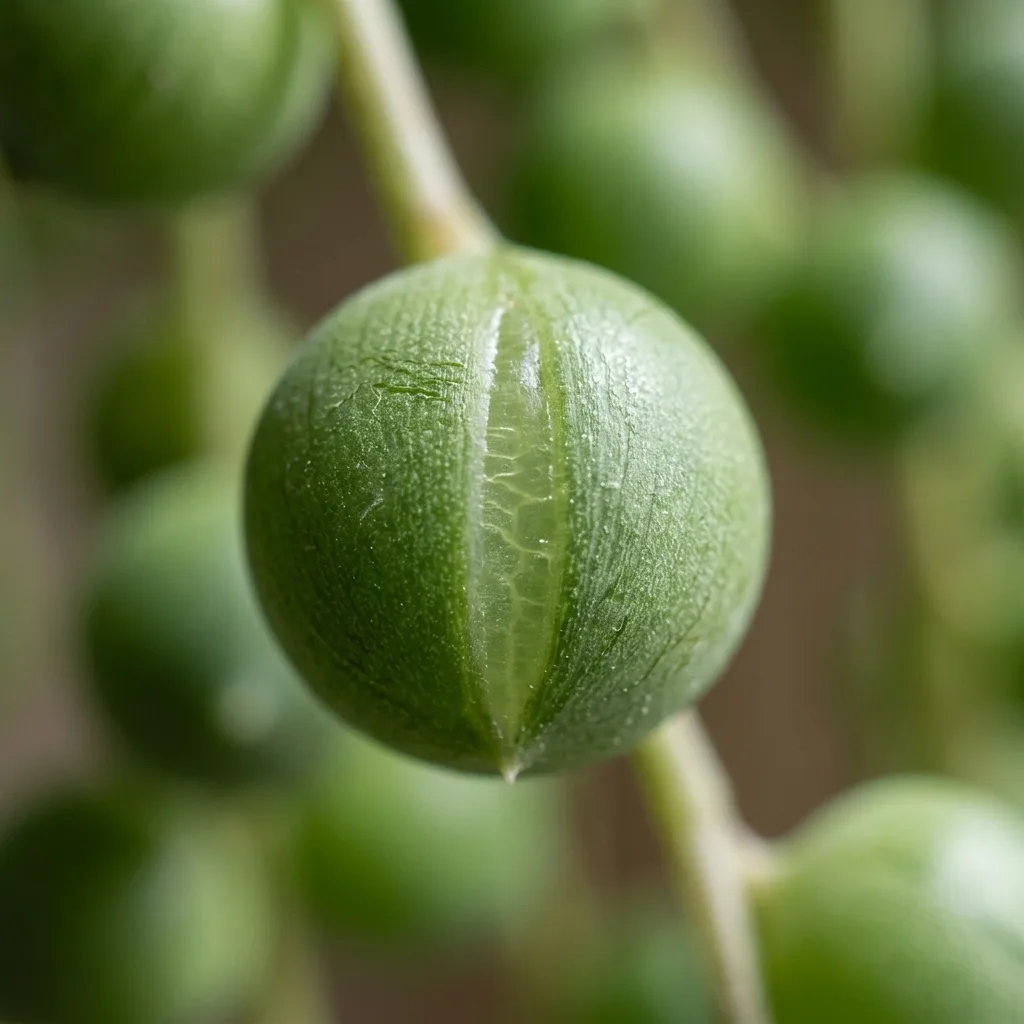
The defining evolutionary hallmark of the genus Curio (such as Curio rowleyanus, Curio radicans, or Curio repens) is its spherical to cylindrical leaf architecture. Geometrically, a sphere possesses the minimum surface-area-to-volume ratio possible for any three-dimensional shape. This evolutionary design drastically minimizes water loss via transpirational vapor exchange under arid winds and intense solar irradiance.
Running lengthwise down each bead are narrow, translucent epidermal strips known as 'epidermal windows' or fenestrations. These specialized tissue zones filter and refract incoming light deep into the interior mesophyll, allowing photosynthesis to proceed while shielding delicate chloroplasts from solar photo-inhibition. Furthermore, Curio species utilize Crassulacean Acid Metabolism (CAM). By opening their stomata exclusively at night to sequester carbon dioxide as malic acid, they preserve internal moisture. Because their stomata remain tightly closed during daylight hours, daytime overwatering combined with stagnant, heavy soil invariably triggers osmotic shock, cellular rupture, and catastrophic root rot within the xylem tissue.
2. Accurate Diagnosis and Plant Symptomology
Decoding the subtle physical cues of Curio succulents is the first line of defense against terminal decline. Both the vascular foliage and the root system provide clear diagnostic signals:
- Etiolation (Light Starvation): Marked elongation of internodal spacing along the vine, accompanied by smaller, underdeveloped beads and pale, washed-out green coloration.
- Loss of Turgor (Cellular Dehydration): Foliage appears dull rather than glossy; the epidermal window recedes into a distinct groove, and beads yield softly when gently compressed between two fingers.
- Root Hypoxia and Edema (Overwatering): Foliage turns translucent, yellow, and gelatinous, detaching effortlessly upon the slightest touch; the potting medium emits a sour, stagnant odor.
- Sunscald (Photo-oxidation): Bleached, straw-colored or crispy brown scar patches erupting across foliage, predominantly occurring on specimens lacking a protective epicuticular farina wax layer or those moved abruptly into direct, unacclimated midday sun.
3. Step-by-Step Cultivation Protocol
To cultivate lush, trailing Curio vines and secure healthy root architecture, follow the protocol refined over decades in our cultivation greenhouses:
- Optimal Exposure: Position the plant where it receives 4 to 6 hours of bright, filtered sunlight daily—ideally near an unobstructed east- or west-facing window. Diffuse harsh, direct summer midday UV rays with a sheer curtain to prevent thermal tissue burn.
- Vessel Architecture: Always select unglazed terracotta containers fitted with ample drainage apertures. Terracotta's micro-porous walls allow excess moisture to evaporate laterally, accelerating soil dry-down and maximizing rhizosphere oxygenation.
- Sub-Irrigation (Bottom-Watering): To prevent standing moisture from settling between densely packed beads and sparking fungal colonization, place the pot into a shallow basin filled with room-temperature, dechlorinated water. Allow the substrate to pull moisture upward via capillary action until the top layer is cool and damp (roughly 15–20 minutes), then lift and let it drain completely.
- Pruning and Apical Decapitation: Trim straggly, sparse runners using sterilized bypass shears. Removing the growing tip suppresses apical dominance driven by auxin hormones, triggering lateral buds to break and substantially thickening the crown of the pot.
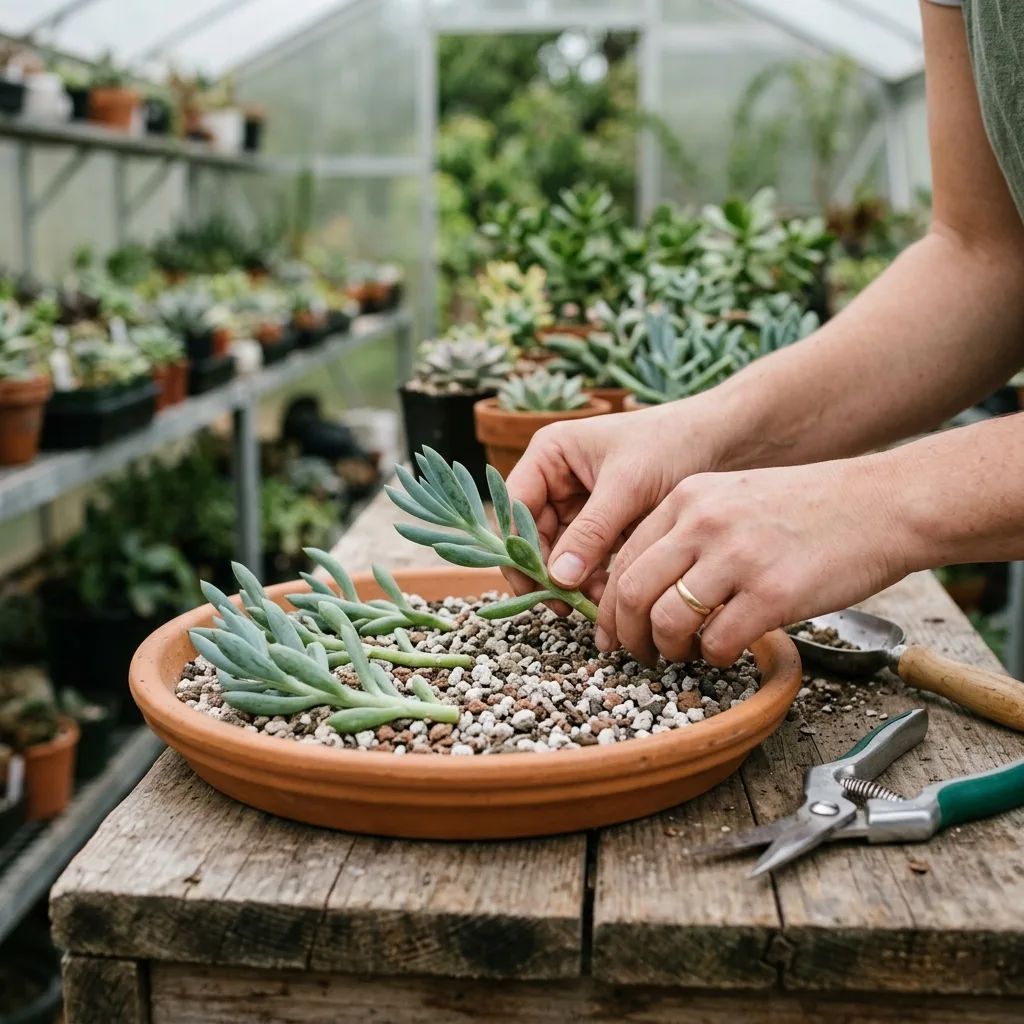
- Stem Cutting Propagation: Allow 8–10 cm healthy stem cuttings to dry in indirect light for 48 hours to develop a protective suberized callus over the cut surface. Coil or lay the cuttings horizontally over a moist, highly mineral substrate and pin them gently; adventitious nodal roots will emerge within 10 to 14 days.
4. Essential Substrate Components, Tools, and Metrics
The root physiology of Curio demands highly porous aeration pockets rather than sustained, dense moisture. The mineral-heavy formulation below creates the ideal physical root zone:
| Component / Parameter | Recommended Proportion / Value | Physiological Function |
|---|---|---|
| Pumice | 40% (3–5 mm grain size) | Maintains macro-pore aeration channels and maximizes drainage velocity. |
| Lava Rock / Zeolite | 20% | Supplies structural trace minerals and promotes high cation-exchange capacity. |
| Coarse Horticultural Sand / Perlite | 15% | Prevents substrate compaction and mechanical root strangulation. |
| Sifted Organic Peat / Coco Coir | 25% (low-fiber) | Supplies baseline moisture retention and initial organic anchoring. |
| Ambient Temperature | 16°C – 26°C (61°F – 79°F) | Supports optimal CAM organic acid synthesis and active vegetative elongation. |
| Irrigation Rhythm | When substrate is 100% dry | Ensures root xylem vessels undergo healthy dry-down cycles between waterings. |
5. Five Common Mistakes and Recovery Strategies
- Mistake 1: Overhead Spraying and Misting: Droplets trapped between crowded spherical leaves create mini-lenses that scorch tissue in bright sun, while persistent moisture triggers localized fungal decay.
Remedy: Water exclusively at the soil level or via bottom-watering. If leaves get wet, circulate ambient air with a small fan until foliage is dry. - Mistake 2: Stashing in Dim Room Corners: Hanging Curio baskets 2 to 3 meters away from light sources on bookshelves causes severe internodal stretching, bead shrinkage, and rapid root demise.
Remedy: Gradually introduce the plant toward a luminous window sill through progressive photic acclimation over two weeks. - Mistake 3: Undrained Terrariums or Massive Pots: Enclosed glass containers lack drainage, leading to toxic mineral salt accumulation and rapid cellular asphyxiation of the root system.
Remedy: Immediately depot the specimen, excise all necrotic root mass with a sterile scalpel, dust remaining tissue with sulfur, and repot into a shallow terracotta saucer. - Mistake 4: Heavy Fertilization During Dormancy: Supplying high-nitrogen synthetic fertilizers when growth is dormant burns tender root hairs and forces weak, structural-deficient cell expansion.
Remedy: Restrict fertilization strictly to active spring and early summer phases, utilizing a balanced, low-nitrogen succulent formulation diluted to quarter-strength once monthly. - Mistake 5: Flooding a Shriveling Plant on Sight: Deflated beads are also caused by dead, rotted roots that cannot intake water; misdiagnosing rot as drought and dousing the pot finishes off the remaining healthy tissue.
Remedy: Inspect soil moisture with a wooden skewer. If the substrate is wet but beads are deflated, root rot has occurred. Sever healthy top vines immediately and restart the plant via stem propagation.
6. Seasonal Management and Long-Term Projections
Spring (Awakening and Vegetative Surge): As ambient temperatures stabilize above 18°C (64°F), Curio kicks into active metabolic growth. Gradually increase sub-irrigation frequency, introduce diluted balanced nutrients, and take tip cuttings to reshape the crown.
Summer (High Heat and Midday Preservation): In sustained heat exceeding 32°C (90°F), CAM plants undergo dormancy protection by slowing enzymatic activity. Guard against intense, unshaded afternoon sun and reserve watering strictly for cooler evening hours.
Autumn (Floral Bud Induction): Marked diurnal temperature swings between warm days and crisp nights stimulate Curio rowleyanus to produce compact, cinnamon-scented brush-like white flower clusters. Maintain exceptional substrate aeration during this reproductive transition.
Winter (Quiescence and Rest): Maintain the plant in a cool, bright area around 10–15°C (50–59°F). Reduce irrigation to an occasional sip once or twice a month, and eliminate all fertilizer inputs. Adhering to this physiological seasonality ensures your Curio transforms year after year into a dense, cascading curtain of vibrant green beads.


Reader Reviews & Comments 3 Reviews
Eleanor Vance
Julian Hayes
Marcus Sterling
Leave a Review & Rating
Share your plant care tips, experiences, or questions with our succulent community.