






Stretching from the blistering sands of the Sonoran Desert to our bright living room windowsills, cacti are indisputably the most sculpted monuments of aridity. Having learned over millions of years of evolution to hoard every precious drop of moisture within the spongy parenchyma tissues of their stems, these ancient flora possess an innate, unyielding defense mechanism against excessive moisture. But is it genuinely possible to take a desert plant naturally accustomed to drought and root it directly in a glass of water? The short answer: Yes, it is technically possible; however, the botanical reality and hidden risks beneath the surface run far deeper than you might imagine.
The greatest misconception plant enthusiasts often fall into is assuming every plant species responds to water identically. Just because a Pothos vine or a Monstera vigorously pushes adventitious roots in a water vessel does not mean a succulent-stemmed desert cactus can endure the same aquatic environment without disintegrating. Without a fundamental understanding of suberized callus formation, dissolved oxygen dynamics, and the traumatic transition of water roots into soil roots, water propagation can quickly become a ticking rot time bomb. In this guide, we examine the cellular responses of cacti submerged in or suspended over water, identify which species actually tolerate this technique, and outline an airtight protocol to harvest healthy roots without losing your specimen.
1. Taxonomic Identity, Areole Architecture, and Spine Morphology
The definitive morphological hallmark that separates the cactus family (Cactaceae) from all other succulent plant groups is a specialized, cushion-like organ known as the 'areole'. Areoles are miniature, condensed meristematic growth hubs distributed across the cactus stem; spines, glochids, lateral offsets, and blossoms emerge directly from these focal points. Spines themselves are modified evolutionary leaves that surrendered photosynthetic duties to the green stem cortex. Through this precise adaptation, the plant reduces transpirational water loss to near absolute zero.
Whenever you prepare a cactus cutting for water propagation, the excised wound completely lacks the protective epidermal cuticle and epicuticular wax (farina). True desert cacti (such as Mammillaria, Echinopsis, or Opuntia) store dense concentrations of mucilage and water-storing parenchyma cells within their cut stem sections. If this freshly sliced tissue is submerged directly into water before cellular healing occurs, pathogenic bacteria and waterborne oomycetes flood the unshielded cells before areolar defenses can mobilize. Conversely, rainforest epiphytic cacti (such as Schlumbergera—the Holiday Cactus—or Epiphyllum—the Fishbone Cactus) evolved on tropical tree canopies in saturated ambient humidity; their anatomical predisposition allows them to initiate adventitious water roots around their areoles far more rapidly and safely.
2. Light Standards, Solar Intensity, and Air Circulation
During the rooting phase, a detached cactus cutting redirects its stored photosynthetic reserves toward cellular differentiation and root primordia development (rhizogenesis). However, exposing the cutting to direct, blistering sunlight at this stage is a recipe for catastrophic failure. Intense solar radiation rapidly heats the water within a transparent glass vessel, producing a localized greenhouse effect that drastically depletes dissolved oxygen levels. Deoxygenated, warm water essentially parboils the base of the cactus, collapsing the cell walls within hours.
Instead, position your propagation vessel where it receives at least 6 to 8 hours of bright, indirect daylight filtered through a sheer curtain. Ambient air circulation is non-negotiable; stagnant, stuffy corners accelerate surface biofilm buildup and foster anaerobic bacterial colonization. A gentle, continuous flow of clean air stimulates the stomata on the crown while keeping the lower rooting zone cool and well-aerated.
3. Hydration Cycles and the Critical Dormancy Window
Cactus metabolism shifts dramatically depending on the season. During late autumn and winter, cacti drastically throttle back their CAM (Crassulacean Acid Metabolism) pathway and enter an essential winter rest (dormancy). When ambient temperatures drop around 10–12°C (50–54°F), cellular division grinds to a halt. Severing a cactus and placing it into water during this dormancy phase is not an act of propagation; it is effectively signing a wet death warrant.
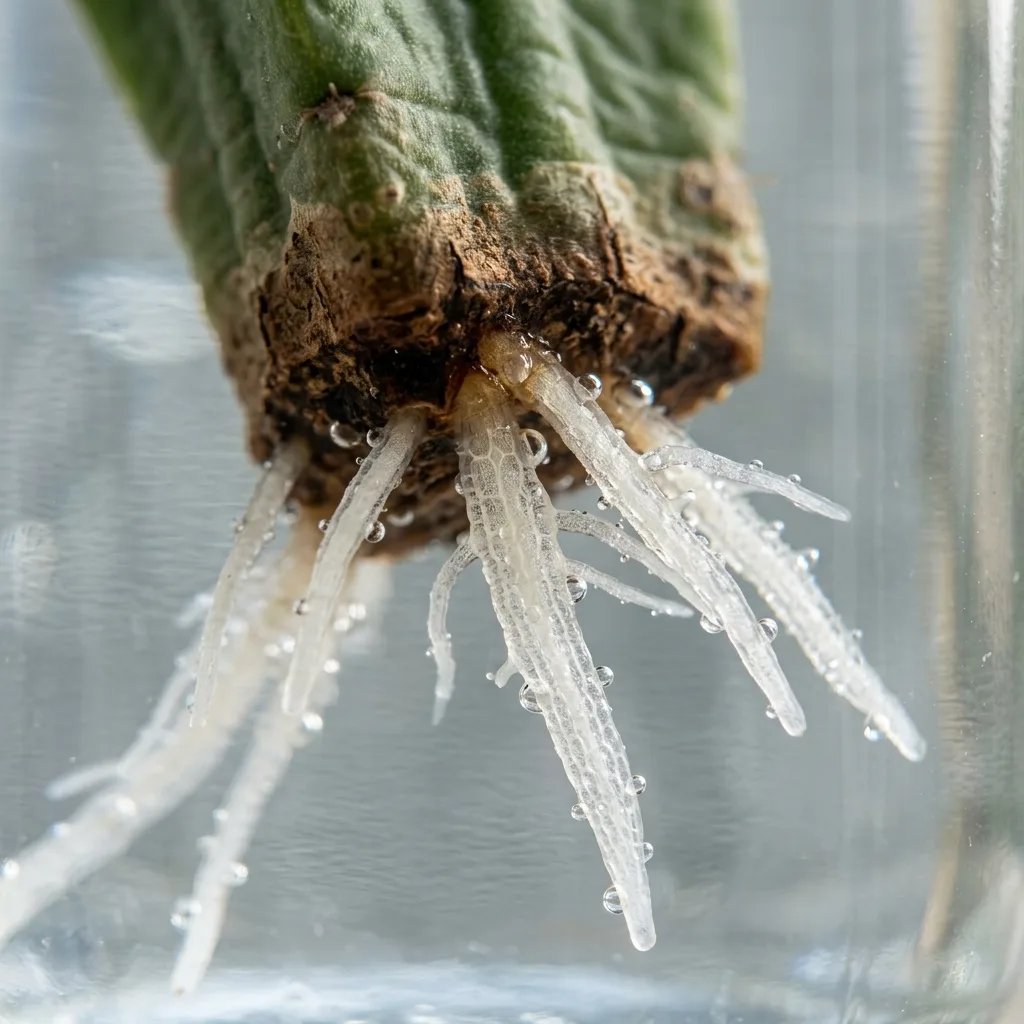
Water rooting should only be initiated during active vegetative growth—from mid-spring through late summer. In water culture, moisture management revolves around water purity and oxygen replenishment. Refresh the reservoir once every 7 to 10 days using chlorine-free, room-temperature water. Crucially, the water level must never drown the green tissue of the stem. The objective is to submerge only the basal 2 to 3 millimeters of the callused wound, or better yet, suspend the cutting mere millimeters above the water line so it bathes purely in the rising humidity vapor.
4. High-Mineral Cactus Substrate and Potting Requirements
Roots generated in an aquatic medium are anatomically termed 'water roots'. Under microscopic examination, these roots are exceptionally fragile, have a low density of root hairs, and feature broad intercellular cavities (aerenchyma-like spaces) engineered to extract oxygen from saturated liquids. However, a cactus cannot thrive permanently in plain water; devoid of mineral nutrition, the succulent stem eventually exhausts its reserves and undergoes chlorosis. As soon as these adventitious water roots attain a length of 1.5 to 2 cm (about 0.75 inches), the cutting must immediately be potted into a high-mineral cactus substrate.
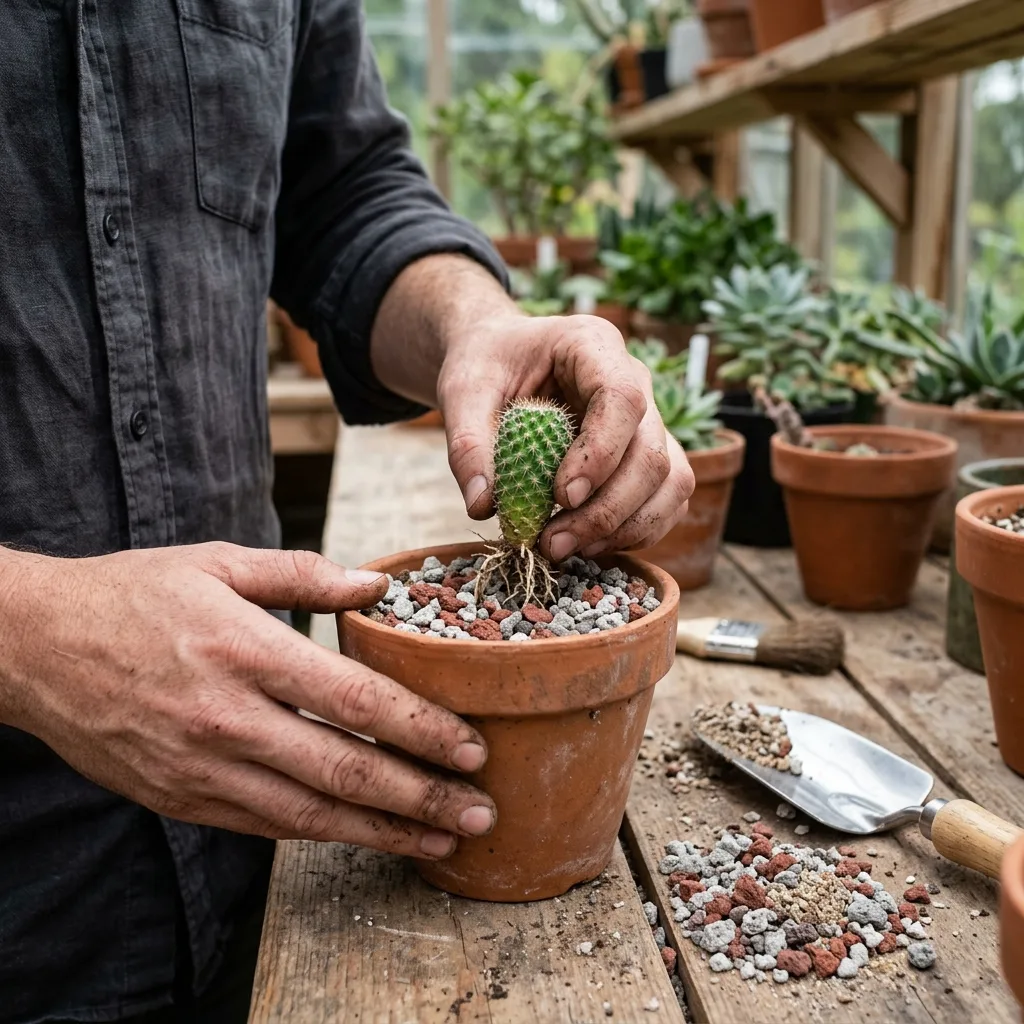
During this delicate transition to soil roots, your container choice must be unglazed terracotta featuring generous drainage holes. The potting mix must provide maximum porosity to prevent crushing or suffocating the delicate, water-adapted root structures.
| Component Category | Material | Mix Ratio (%) | Botanical Function |
|---|---|---|---|
| Inorganic / Mineral | Pumice (3–5 mm grit) | 40% | High internal porosity, root aeration, and moisture buffering |
| Inorganic / Mineral | Lava Rock (Scoria) + Zeolite | 30% | Micronutrient reserve, prevents compaction, maximizes drainage |
| Inorganic / Mineral | Coarse Quartz River Sand | 10% | Creates fine capillary drainage pathways |
| Organic | Screened Peat / Coconut Coir | 20% | Light organic base for initial root anchoring |
5. Flowering Dynamics and Post-Rooting Nutrition
Under no circumstances should chemical fertilizers or concentrated liquid feeds be added to the rooting water. Soluble salts and synthetic nitrogen will immediately scorch the delicate callus tissue and blister nascent root tips. A cactus harnesses its blooming vitality only after it establishes an extensive, sturdy root network in soil over subsequent seasons.
Once your newly potted cactus shows indisputable signs of active vegetative extension, you may introduce a low-nitrogen, high-phosphorus, and high-potassium fertilizer formulated specifically for cacti (e.g., NPK 5-10-10) during the height of spring. Remember: The genuine catalyst for spectacular cactus blossoms is not chemical feeding, but rather a crisp, bone-dry winter dormancy followed by generous exposure to warm, unfiltered spring sunlight.
6. Advanced Propagation: The Suspended Method and Grafting
If you want to leverage water rooting while minimizing the risk of bacterial decomposition to zero, utilize the 'Suspended Water Method'. Secure clear plastic wrap across the rim of a clean glass jar, punch a small hole through the center, and seat your thoroughly callused cutting upright. Ensure the base remains suspended 1 to 2 cm strictly above the water surface. Detecting the ambient humidity beneath it, the cactus exhibits positive hydrotropism—growing downward-directed root filaments across the air gap toward the moisture without suffering tissue saturation.
Nevertheless, for classic desert species, dry rooting over horticultural pumice remains the gold standard. Furthermore, if you are handling achlorophyllous (chlorophyll-deficient) mutant cultivars, such as the fluorescent red or yellow 'Moon Cactus' (Gymnocalycium mihanovichii f. variegata), neither water nor soil rooting is viable. Lacking their own photosynthetic machinery, these scions must be grafted directly onto a robust, green Hylocereus or Trichocereus rootstock.
7. Defending Against Fungal Pathogens and Tissue Necrosis
The primary fungal antagonists in water rooting protocols belong to the genera Fusarium, Phytophthora, and Pythium. If you detect any softening, translucence, darkening, or an uncharacteristic sour odor around the submerged basal tissue, you must intervene immediately.
As an emergency triage, extract the specimen from the vessel. Using an ethanol-sterilized scalpel, excise the diseased tissue horizontally until every trace of vascular browning vanishes and you reach pristine, apple-green pulp. Dust the fresh cut with finely ground sulfur or horticultural cinnamon (a natural antifungal agent). Set the cutting aside in a breezy, shaded spot for an entire week to re-form a rock-solid callus—and this time, steer clear of water immersion entirely by rooting it on dry pumice.


Reader Reviews & Comments 3 Reviews
Eleanor Vance
Marcus Sterling
Clara Higgins
Leave a Review & Rating
Share your plant care tips, experiences, or questions with our succulent community.