






Concealed along rocky slopes and under the dappled shade of semi-arid scrublands throughout eastern and southern Africa, Bowiea volubilis (the Climbing Onion) stands as one of the botanical world's most alluring paradoxes. Instead of retreating beneath the subterranean soil, an emerald-green spherical bulb perches proudly atop the substrate, sending forth an ethereal, lacy cascade of twining flowering stems racing toward the sky. Functioning in the succulent realm without true persistent leaves, this architectural masterpiece conducts photosynthesis directly through its stem framework, bringing the rugged resilience and quiet majesty of the African savannah into our living spaces.
For growers accustomed to conventional foliage houseplants, this specimen offers a striking departure: it is an evolutionary fortress engineered specifically for moisture conservation. While the concentric fleshy scales of the bulb store pure water reserves and structural carbohydrates, the sprawling aerial web of green cladodes undertakes all photosynthetic labor. Tragically, countless enthusiasts lose this gem either by burying the bulb entirely underground like a common garden tulip or by drowning it during its natural resting phase. Once you understand its cellular dynamics and seasonal rhythm, Bowiea volubilis reveals itself as one of the most rewarding, low-maintenance, and long-lived companions in your collection.
1. Botanical Biology and Physiological Foundations
Taxonomically assigned to the Hyacinthaceae (or broadly circumscribed Asparagaceae) family, Bowiea volubilis is a specialized geophytic succulent. The plant's true foliar leaves are radically vestigial; minute ephemeral scales emerge from the central apical growth point at the start of the season and desiccate almost immediately. The sprawling, lace-like green network that can climb 2 to 3 meters is botanically a highly branched, persistent inflorescence stem system functioning via modified cladodes. Chloroplasts are densely concentrated within these photosynthetic stems, capturing ambient light while minimizing transpirational surface area.
The bulb itself operates as an extraordinary water-retention caudex. Successive layers of swollen tunic scales pack immense quantities of hydration into expansive intracellular vacuoles, ensuring survival through prolonged dry spells. However, this parenchymatous tissue is exceptionally vulnerable to anaerobic suffocation; prolonged contact with waterlogged, heavy soils quickly triggers bacterial or fungal soft rot driven by pathogens such as Fusarium and Erwinia. This vulnerability explains why in habitat, at least two-thirds of the bulb sits fully exposed to atmospheric airflow among rocky crevices. While young, green tunic scales actively photosynthesize; as outer layers mature, they turn into a papery, parchment-like tunic that acts as a thermal shield against blistering desert heat.
2. Accurate Diagnostics and Symptoms of Stress
Cultivating a thriving climbing onion means learning to read the morphological language of its bulb and shoots. Physical cues provide real-time diagnostic insight into the status of its root zone and fluid equilibrium:
- Bulb Softening or Spongy Deflation: Gently compressing the sides of the bulb should meet firm resistance. If it feels deflated or yielding, evaluate the substrate immediately. In bone-dry soil during peak summer growth, the plant has merely depleted its vacuole storage and needs deep irrigation. In damp or cold soil, this signals catastrophic root asphyxiation and the onset of internal bulb rot.
- Premature Shoot Desiccation or Yellowing: When the lacy vines turn straw-colored in late autumn or early winter, celebrate: your plant is entering its natural seasonal dormancy, pulling resources back into the bulb. However, if stems collapse and brown abruptly mid-season, it points to localized root damage, mechanical stem trauma, or insufficient light.
- Etiolated, Weak, and Spindly Stems: Abnormally elongated stem segments with pale color and wide internodal gaps indicate severe light starvation. The climbing onion is burning vital bulb sugars in a desperate stretch toward brighter ambient conditions.
- Foul Odor and Dark Basal Discoloration: A blackening base accompanied by a damp, sour odor indicates fungal pathogen invasion along the basal root plate. Without immediate surgical intervention, the entire bulb will liquefy within days.
3. Step-by-Step Cultivation Protocol
To cultivate an expansive, robust bulb crowned with vibrant green climbing twines year after year, implement these four fundamental protocols:
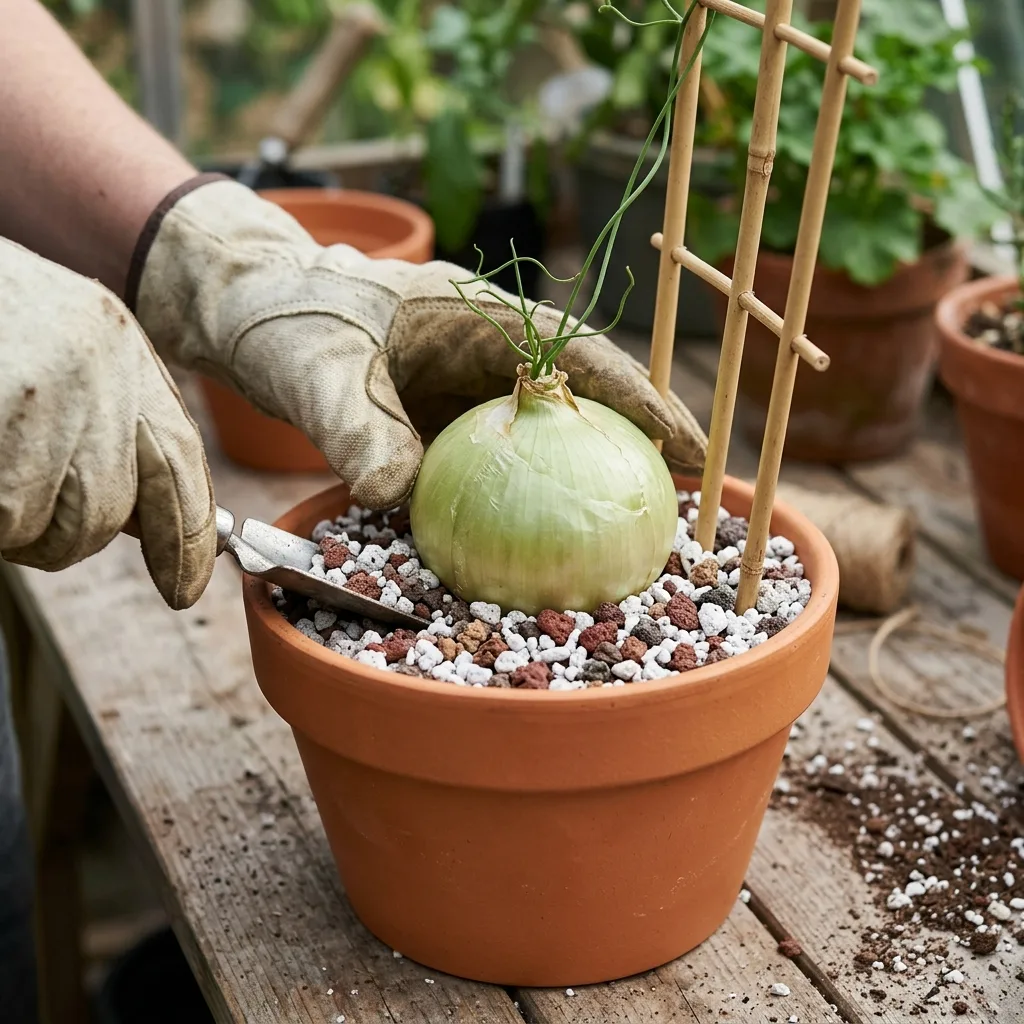
- Correct Planting Depth: Never submerge the bulb beneath the potting mix. Situate only the basal root plate and the bottom one-third of the bulb into the substrate. The upper two-thirds must remain fully elevated above the soil line, surrounded by open air to eliminate the possibility of collar rot.
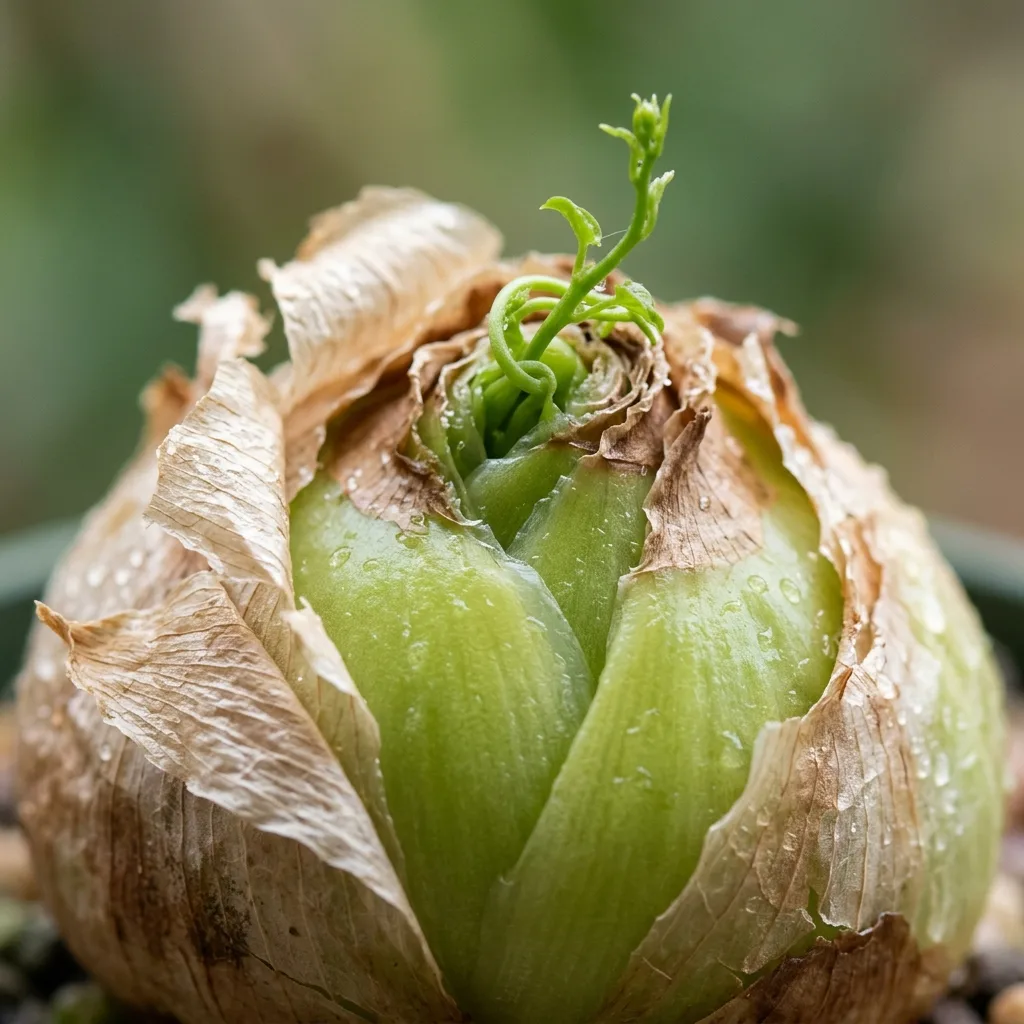
- Erecting the Climbing Framework: When active growth resumes, shoots can surge between 3 to 5 cm daily. The moment a green tip sprouts from the apical crater, insert a sturdy bamboo hoop, wire armature, or decorative copper trellis into the pot perimeter. Gently train the tender growing tip toward the support without kinking it; unguided vines tumble onto the substrate, obstructing light and trapping humidity.
- Cyclical Irrigation Rhythm: While actively producing green foliage, adhere strictly to a 'soak-and-dry' schedule. Always direct water around the inner lip of the container onto the soil, never into the apical indentation atop the bulb. Allow at least 80% of the soil profile to dry out completely before applying moisture again.
- Managing Dormancy Transition: As the active season draws to a close, the climbing vines naturally lose their luster and yellow. Immediately reduce irrigation frequency. Once the vegetative structure is entirely dry and brittle, sever the dead stems 2 to 3 cm above the bulb with sterile shears. Withhold water almost entirely (a light sip every 4 to 6 weeks prevents fine root mortality) and rest the dormant bulb in a cooler, dim, and dry location until fresh growth awakens.
4. Soil Mix Parameters, Microclimate, and Specifications
Root aeration and rapid gravitational drainage are non-negotiable for geophytic succulents. The specialized potting profile outlined below reflects our proven botanical nursery standards:
| Component / Parameter | Standard / Recommended Measure | Botanical Function & Justification |
|---|---|---|
| Inorganic Mineral Phase | 70% (Pumice, crushed lava rock, coarse perlite) | Provides macroporosity and structural drainage channels to eliminate root asphyxiation. |
| Organic Phase | 30% (High-grade peat or buffered coco coir) | Maintains minimal moisture buffer for root hairs and anchors beneficial rhizosphere biology. |
| Container Medium | Unfinished Terracotta (with drain holes) | Microporous clay walls promote continuous gas exchange and accelerate substrate desiccation. |
| Lighting Profile | Bright indirect light with gentle morning sun | Fuels high photosynthetic efficiency in the cladodes while preventing bulb sunburn. |
| Irrigation (Active Phase) | Every 7 to 10 days (after complete soil dry-down) | Replenishes cellular xylem vessels, maintaining hydrostatic bulb turgor. |
| Irrigation (Dormancy Phase) | Every 4 to 6 weeks (minimal peripheral sip) | Prevents fine feeder root desiccation without triggering active bulb decay. |
5. Five Critical Cultivation Mistakes & Rescue Plans
- Mistake 1: Burying the Bulb Completely in Soil.
Rescue Plan: This is the single most common cause of mortality. Trapped against moist organic substrate, the fleshy tunic scales succumb to rot in weeks. Immediately unpot the plant, brush away all media, slice away any decayed tissue, dust the wounds with sulfur powder, and repot with two-thirds of the bulb resting entirely above the surface. - Mistake 2: Pouring Water Directly into the Apical Growth Point.
Rescue Plan: Stagnant water sitting in the center crater of the bulb induces apical meristem necrosis. Always pour water exclusively around the pot edge. If water splashes onto the crown, wick it away immediately using the corner of a clean paper towel. - Mistake 3: Panicked Overwatering at the First Sign of Yellowing Stems.
Rescue Plan: Growers often misinterpret natural dormancy as dehydration and saturate the soil, rotting the bulb just as it shuts down its root activity. Recognize yellowing as a natural transition; halt heavy irrigation, cease fertilizing, and allow the vine to finish desiccating on its own schedule. - Mistake 4: Leaving Twining Vines Unsupported.
Rescue Plan: Vines left without vertical climbing structures collapse into a tangled mat across the soil surface, impeding air circulation and creating a microclimate that invites mealybugs. Stake the pot promptly with an arch or small trellis and gently wind the stems upward. - Mistake 5: Heavy Fertilization During Dormancy.
Rescue Plan: A resting bulb cannot assimilate nutrient salts. Excess fertilizer crystallizes around inactive roots, causing severe chemical burn. Restrict feeding exclusively to early and mid-growth cycles, utilizing a balanced succulent formula diluted to one-quarter strength.
6. Seasonal Calendar and Long-Term Specimen Development
Aligning your horticultural practices with the physiological clock of Bowiea volubilis guarantees a specimen that expands in diameter over decades, forming clustered offsets and producing spectacular botanical displays:
- Spring (Awakening & Emergence): As photoperiod increases, a vibrant green vegetative point emerges from the crown. Gradually step up your watering cadence, install the trellis system, and administer a quarter-strength succulent fertilizer once a month.
- Summer (Peak Vegetative & Inflorescence Stage): The climbing lace blankets the support and erupts with tiny, star-shaped, pale greenish-yellow blooms. Keep the pot in a breezy, luminous location shielded from searing midday rays. Water deeply whenever the mix dries out completely.
- Autumn (Nutrient Translocation & Storage): Sucrose and carbohydrates generated via photosynthetic activity are translocated down into the bulb scales, causing the caudex to expand and firm up. As shoot tips gradually lose color, withhold fertilizer and begin extending the intervals between waterings.
- Winter (Dormancy & Vernalization): The plant rests bare. Ambient temperatures should hover between 10°C and 15°C (50°F–59°F). Protect the bulb rigorously from frost and provide only an occasional minimal sip of water once a month. This cold, dry rest is biologically essential to prime the apical buds for a vigorous surge next spring.


Reader Reviews & Comments 3 Reviews
Julian Vance
Marcus Sterling
Clara Higgins
Leave a Review & Rating
Share your plant care tips, experiences, or questions with our succulent community.