






In plant physiology, soil is not merely a static medium that physically anchors roots; it is a dynamic biological filter where gas diffusion, capillary water movement, and the rhizosphere microbiota operate continuously. Species characterized by semi-succulent tissues and vigorous root metabolisms, such as Abutilon megapotamicum—known to botanical enthusiasts as trailing abutilon or weeping Chinese lantern—rapidly enter a state of hypoxia (oxygen deprivation) when confined in compacted, anaerobic media. Whether utilizing nocturnal Crassulacean Acid Metabolism (CAM) or diurnal C3/C4 respiratory pathways, succulents and plants with dense root fibers require an uninterrupted supply of dissolved oxygen for cellular adenosine triphosphate (ATP) synthesis within root cells.
When compacted, heavy clay-laden, or structurally degraded peat substrates are irrigated, the micropores become entirely flooded with water, halting gas exchange along the apoplastic pathways of root tips. This induces ethanol fermentation within root cells, triggering lysosomal rupture and opening infection pathways for opportunistic oomycetes such as Phytophthora and Pythium. The key to successful cultivation lies in engineering porous inorganic matrices that drain excess free water rapidly while maintaining an ultra-thin capillary film of moisture across the rhizosphere.
1. Comparative Analysis of Inorganic Mineral Components
The foundational pillar of long-term root health is the incorporation of inorganic minerals with carefully calibrated grain sizes (ranging from 2 to 6 mm). While fine sand or mineral dust clogs substrate voids and leads to concrete-like compaction, angular and porous mineral fractions guarantee continuous root aeration.
- Pumice: With its high silicate content and vesicular, sponge-like structure, pumice remains lightweight while providing micro-recesses for root hairs to anchor securely. It offers balanced moisture retention and does not break down or compact over time.
- Lava Rock (Volcanic Scoria / Basaltic Tuff): Its sharp, angular geometry prevents the substrate matrix from collapsing. Rich in trace iron and magnesium, its heavier mass provides structural stability, preventing top-heavy or trailing plants in deep pots from tipping over.
- Zeolite (Clinoptilolite): Boasts the highest Cation Exchange Capacity (CEC) among inorganic soil amendments. It binds excess potassium, calcium, and ammonium ions, releasing them gradually into the rhizosphere according to plant demand, while chemically suppressing the proliferation of anaerobic root-rot bacteria.
- Expanded Clay (Leca / Akadama): Fired Japanese Akadama clay features a granular structure that visibly shifts color upon hydration, simplifying moisture tracking; however, because it gradually degrades into dust, it should be refreshed every 2 to 3 years.
2. Balancing Organic Matter: Peat, Coco Coir, and Compost
Completely inorganic hydroponic-style systems require stringent nutrient management. Under standard home and greenhouse conditions, organic matter should be integrated judiciously to provide natural buffering capacity. However, conventional garden soil or degraded forest humus quickly transforms into an active decomposition zone within closed container ecosystems.
Sphagnum peat moss offers moisture retention with an acidic pH range (5.5 - 6.2) and a fibrous texture; yet, once completely dried, it turns hydrophobic and channels water along the pot walls rather than absorbing it. In contrast, Coco Coir (derived from processed coconut husks) exhibits outstanding re-wetting capabilities and maintains a near-neutral pH that will not scorch fragile root tips. Compost should only be introduced in the form of fully stabilized worm castings (vermicompost), strictly limited to 5-10% of the total mix volume.

3. Custom Substrate Formulations for Diverse Species and Climates
Every botanical group possesses distinct drought adaptations and root epidermis morphologies. The aeration and porosity requirements of thick-rooted Haworthia species, desert cacti shielded by thick cuticles and farina, and semi-succulent woody species are formulated below:
| Plant Group / Species | Inorganic Fraction (%) | Organic Fraction (%) | Recommended Grain Size | Core Substrate Components |
|---|---|---|---|---|
| Abutilon megapotamicum & Semi-Succulents | 50% | 50% | 2 - 4 mm | 30% Pumice, 20% Lava Rock, 35% Coco Coir, 15% Perlite/Worm Castings |
| Haworthia & Gasteria | 70% | 30% | 3 - 5 mm | 40% Pumice, 20% Zeolite, 10% Akadama, 30% Fibrous Peat |
| Echeveria & Pachyphytum | 65 - 70% | 30 - 35% | 2 - 5 mm | 35% Pumice, 20% Lava Rock, 10% Perlite, 35% Coco Coir |
| Desert Cacti (Mammillaria, Ferocactus) | 80 - 85% | 15 - 20% | 3 - 6 mm | 40% Lava Rock, 30% Pumice, 15% Zeolite, 15% Coarse Peat Fiber |
| Lithops & Sensitive Mesembs | 90% | 10% | 2 - 4 mm | 50% Pumice, 25% Zeolite, 15% Crushed Quartz, 10% Organic Matter |
4. Container Material Selection: Terracotta, Unglazed Ceramic, and Plastic
The material composition of your container directly dictates substrate drying velocity and root rhizosphere thermal stability:
- Unglazed Terracotta: Thanks to its microporous walls, moisture evaporates not only through the bottom drainage hole but across the entire vessel exterior. This promotes gas exchange throughout the root zone and dramatically mitigates overwatering risks. During summer, the resulting evaporative cooling shields roots from thermal stress.
- Unglazed Ceramic / Stoneware: Heavy and stable; as long as the exterior remains unglazed, it provides breathability comparable to terracotta. It offers exceptional ballast for pendulous, top-heavy trailing species.
- Plastic and Glazed Containers: Provide zero wall evaporation. Moisture escapes exclusively through the top substrate surface and bottom drainage holes. Substrate drying times can be 2 to 3 times longer than in terracotta; when using these containers, increase the inorganic mineral ratio by at least 15-20%.
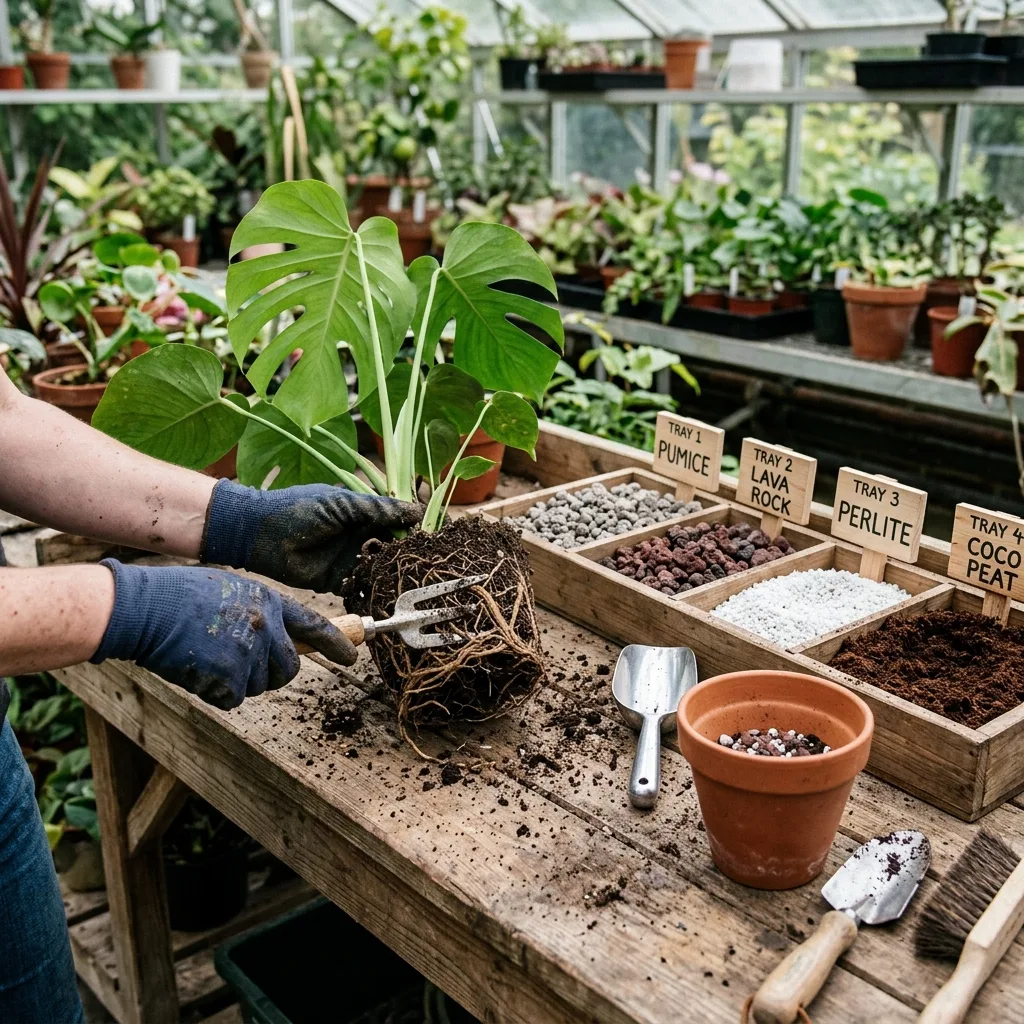
5. Step-by-Step Repotting and Root Pruning Protocol
- Timing: The optimal window for repotting occurs in early spring as metabolic activity ramps up, or immediately following the conclusion of winter dormancy.
- Depotting and Root Cleaning: Withhold water for 4 to 5 days prior to unpotting. With the root ball completely dry, invert or tilt the container and gently flex the sides to ease the plant out. Carefully tease away old, depleted, and compacted soil using a blunt wooden chopstick without stripping primary root structures.
- Root Pruning: Using sterilized pruning shears, excise any blackened, mushy, hollow, or root-bound circling fibers. Preserve healthy, firm, white root tissue. Dust all fresh cuts with activated charcoal powder or ground cinnamon to provide a natural antimicrobial seal.
- Settling into the New Pot: Select a new container only 2 to 3 cm wider in diameter than the previous one; excessively oversized containers retain an uninhabited volume of damp soil that resists drying. Center the plant, spread the roots naturally, and backfill with your uniform mineral blend, tapping the pot sides gently to settle the particles and eliminate subterranean air pockets.
6. Post-Repotting Care: The Critical 'Dry Resting' Rule
The single most destructive mistake made following repotting is saturating the plant immediately under the assumption of providing 'settling water.' The physical handling during repotting inevitably causes micro-fissures across root epidermises and breaks fragile root hairs. Exposing these open lesions to moisture before a protective suberin or callus layer forms provides pathogens with unimpeded entry into the plant's vascular bundles.
After potting, do not water for at least 5 to 7 days. Keep the plant in a bright, warm rehabilitation spot with indirect light and generous air circulation, away from harsh direct sun. Once root wounds have fully callused, administer the first watering thoroughly until excess water drains freely from the bottom holes.


Reader Reviews & Comments 3 Reviews
Julian Vance
Clara Higgins
Marcus Bennett
Leave a Review & Rating
Share your plant care tips, experiences, or questions with our succulent community.