






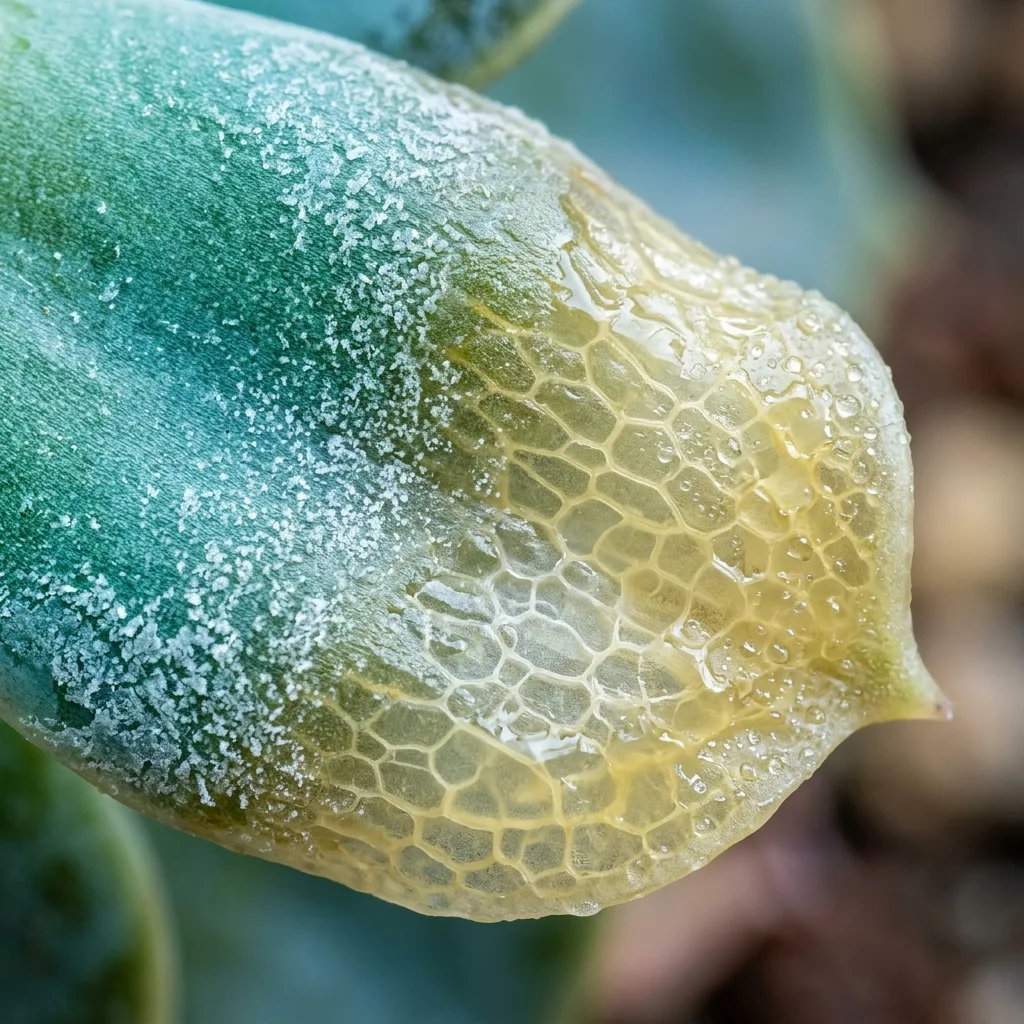
You pick up your morning coffee, glance over at your curated windowsill oasis, and your heart sinks at an unsettling sight: the lower foliage of your favorite rosette has completely lost its velvety green luster, shifting into an eerie translucent yellow that looks like a fragile water balloon ready to burst at the gentlest touch. The heartbreaking question echoed by plant lovers worldwide—'why is my succulent turning yellow?'—is in truth a silent cellular distress call. Migrating into our living spaces from the limestone cliffs of Mexico or the parched Karoo plateau of South Africa, these resilient botanical nomads thrive outdoors for weeks without a drop of rain; yet inside our homes, when overwhelmed by suffocating affection, they shut down chlorophyll synthesis and protest by turning yellow.
A yellow leaf is not an immediate death sentence. Before mourning your plant, you must learn to decipher its physiological language. There is an immense biological divide between an aged leaf naturally desiccating into a papery husk and leaf cell walls rupturing from internal hydrostatic overpressure to form a waterlogged, gelatinous yellow mush. In this master guide, distilled from years of hands-on nursery experience rescuing hundreds of compromised specimens, we will unpack the cellular mechanics behind yellowing, perform precise tissue diagnostics, and deploy an emergency intervention protocol to restore your plant to plump, radiant vigor.
1. Botanical Identity and Morphological Characteristics
To demystify why succulents succumb to chlorosis and translucency, we must examine their morphological architecture and cellular water-storage dynamics. Popular genera such as Echeveria, Graptopetalum, Sedum, and Pachyphytum feature specialized succulent tissues engineered to store moisture inside vast intracellular cavities known as vacuoles. These specialized reservoirs maintain basal metabolic functions during prolonged drought. The outer epidermal surface is safeguarded by an impermeable cuticle reinforced with microscopic epicuticular wax crystals, scientifically known as farina. This powdery mantle acts as a natural sunblock, suppressing transpiration and shielding internal chloroplasts from ultraviolet scorching.
Chloroplasts synthesize chlorophyll pigments, endowing succulents with their signature plump green hues. When cultural conditions deteriorate, the balance of water and dissolved solutes translocated from the root system collapses. When the volume of water forced up through the xylem vessels overwhelms intracellular turgor thresholds, cell membranes distend and rupture under osmotic edema. As these membrane barriers disintegrate, chlorophyll molecules degrade catastrophically, leaving the leaf devoid of green pigment and yielding a jelly-like, waterlogged translucent appearance. Correctly interpreting leaf discoloration requires a discerning eye for leaf firmness and phyllotaxis (leaf arrangement) across specific genera.
2. Photoperiod Requirements and Indoor Microclimates
One of the most insidious triggers of yellowing is photoperiod deficiency—a chronic lack of usable light. Evolving under intense solar exposure where they absorb 6 to 8 hours of unfiltered sunshine daily, succulents relegated to north-facing windowsills or deep interior rooms throttle their photosynthetic engine to a crawl. Deprived of sufficient photons, the plant halts chlorophyll biosynthesis. This physiological starvation manifests as etiolation (the stem stretching and weakening as it searches for light) coupled with diffuse chlorosis. Leaves yellowing from insufficient illumination do not become bloated or translucent; instead, they turn a dull, lackluster, straw-like hue.
When positioning your collection, unobstructed east-facing windowsills offering crisp morning sun or south-to-southwest exposures softened by sheer drapery during peak afternoon hours provide the gold standard. If your plant has been languishing in a dim corner, abruptly thrusting it into direct midsummer sun will spark a secondary catastrophe: severe photodamage, thermal leaf scalding, and scorched amber-brown decay. Light intensity must always be dialed up gradually, nudging the pot roughly a foot closer to the light source every 3 to 4 days.
3. Irrigation Discipline: The 'Soak and Dry' Methodology
Let us be entirely direct: roughly 85% of succulent yellowing stems directly from chronic overwatering. Dousing your succulents on a rigid weekly calendar is not an expression of care; it is an unintentional asphyxiation of the root system. Utilizing Crassulacean Acid Metabolism (CAM photosynthesis), these desert natives open their stomata exclusively at night to sequester carbon dioxide without dehydrating. A substrate that remains continually damp prevents delicate root hairs from executing gas exchange. Starved of oxygen, root cells undergo rapid necrosis and rot, terminating vascular transport. This creates an extraordinary biological paradox: despite sitting in wet soil, the plant can no longer draw moisture upwards, forcing it to cannibalize its own leaves while flooded lower foliage bursts and turns to yellow jelly.
The universal botanical remedy is the time-tested 'Soak and Dry' protocol. Prior to introducing moisture, insert a clean wooden skewer to the absolute bottom of the container; unless it emerges completely dry with zero clinging soil particles, do not water. When irrigation is warranted, saturate the substrate thoroughly until water streams freely from the drainage holes, then discard all standing runoff from the saucer within 15 minutes. Never mist the foliage; water trapped within the crown or leaf axils rots the apical meristem and turns leaf attachment points into yellow mush.
4. Engineered Substrate Formulation and Container Dynamics
Your potting medium is the first line of defense against leaf discoloration. Conventional peat-heavy potting mixes retain water like a sponge, keeping indoor root systems dangerously submerged for weeks. A high-performance succulent substrate must ensure rapid gravitational drainage and provide structural macropores that keep subterranean zones fully oxygenated.
| Component | Ratio (%) | Botanical Function |
|---|---|---|
| Fine Horticultural Pumice (3-5 mm) | 40% | Establishes persistent aeration channels, maximizing rhizosphere gas exchange. |
| Crushed Lava Rock / Scoria | 20% | Maintains mild structural acidity while delivering trace minerals and iron. |
| Zeolite (Clinoptilolite) | 10% | Adsorbs excess fertilizer salts and regulates moisture micro-fluctuations. |
| Clean Screened Peat or Coco Coir | 20% | Supplies balanced organic matter for fibrous root anchorage. |
| Coarse Perlite / Washed River Sand | 10% | Accelerates percolation and prevents long-term substrate compaction. |
Container physics are just as influential as the blend inside. Unglazed, porous terracotta pots reign supreme; their permeable walls facilitate lateral evaporation, pulling trapped water out of the core rhizosphere. Conversely, plastic and glazed ceramic vessels trap moisture inside. If using glazed pots, generous drainage openings are non-negotiable.
5. Step-by-Step Propagation and Surgical Rescue Techniques
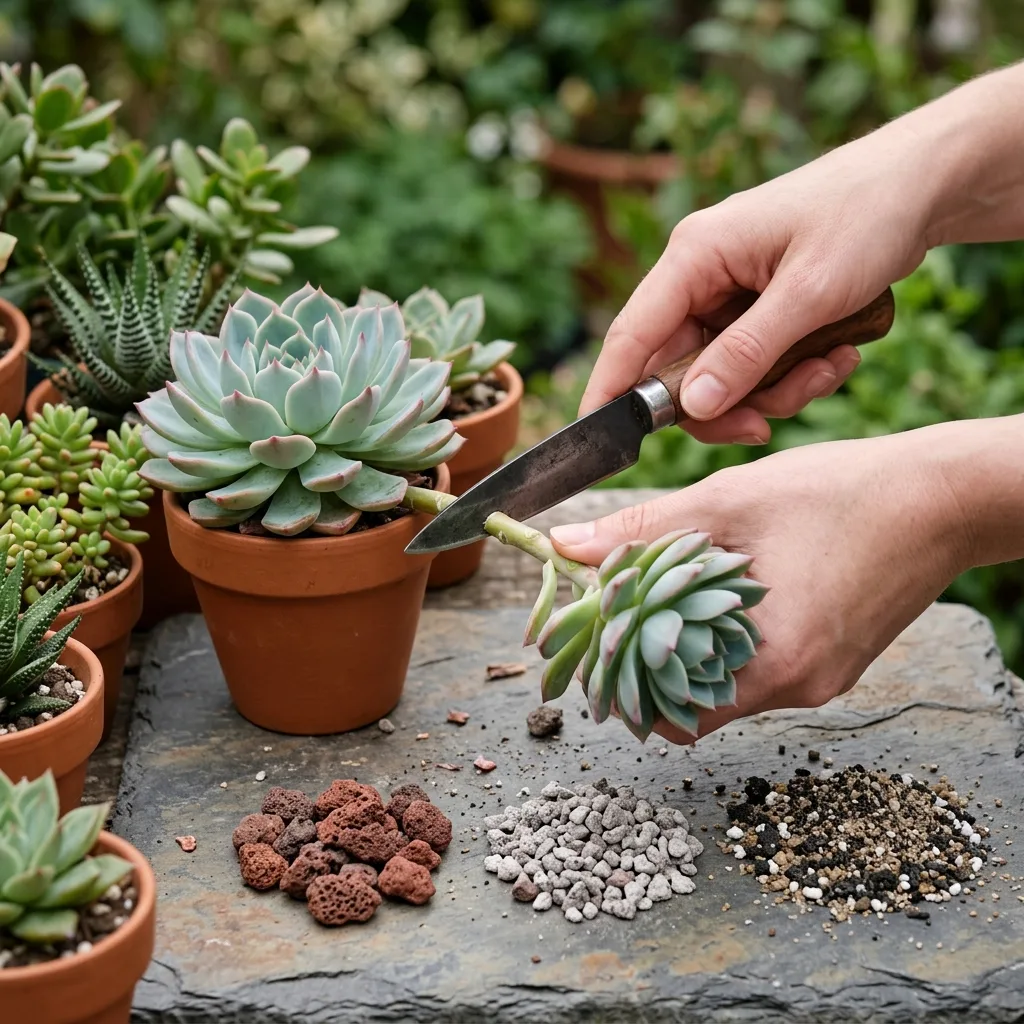
When systemic chlorosis takes hold and stem rot looms, proactive propagation is your sharpest weapon. If the condition is restricted to the basal tier and the central caudex remains firm and turgid, gently rock the yellowed, waterlogged leaves side-to-side until they snap cleanly away from the stem. However, if dark vascular discoloration has begun climbing the stem base, surgical beheading is imperative:
- Sterile Excision: Using a razor blade or scalpel sterilized with 70% isopropyl alcohol, make a clean, horizontal cut at least 1 to 2 centimeters above the uppermost visible sign of black or brown decay, ensuring you cut strictly into pristine, pale-green tissue.
- Callus Formation: Never plant a freshly cut rosette directly into soil. Rest the cutting in an airy, shaded, dry location for 4 to 7 days until the cut wound calluses into a dry, hardened seal. This barrier prevents fungal pathogens from colonizing the vascular bundles.
- Dry Rooting: Place the callused cutting gently atop dry, mineral-dominant succulent soil. Withhold all water for the initial 10 to 14 days. Driven by survival instincts, the plant will draw upon its stored internal reserves to trigger adventitious root formation, producing fresh pink root tips within 3 to 4 weeks.
6. Common Pathogens, Pests, and Therapeutic Countermeasures
Not every case of chlorosis originates from water or illumination issues; parasitic infestations can drain leaf turgidity from the inside out. Watch for these primary culprits:
- Mealybugs (Pseudococcidae): These pervasive pests shroud themselves in white cottony secretions within tight leaf joints. Piercing the epidermis to siphon phloem sap, they trigger localized chlorosis, leaf deformation, and premature defoliation. Spot-treat individuals using a cotton swab dipped in 70% isopropyl alcohol; heavy infestations demand cold-pressed neem oil emulsions or systemic insecticides.
- Spider Mites (Tetranychidae): Thriving in hot, dry environments, these arachnids spin delicate webbing beneath leaves. Their puncturing feeding habit produces stippled, bronze-yellow bleaching accompanied by a rough texture. Increase localized air circulation and apply targeted miticides.
- Root Rot Fungi (Fusarium and Phytophthora): Triggered by persistent dampness, these fungal pathogens destroy the subterranean root cortex. Foliage turns transparent yellow, and the plant easily detaches from the soil level. Rescue requires cutting away all diseased roots and applying a systemic copper-based fungicide before repotting into sterile media.
7. Seasonal Rhythm Calendar and Horticultural Protocols
Synchronizing your care regimen with the natural phenology of succulents is the ultimate defense against chronic chlorosis:
- Spring (Growth Awakening): The vegetative cycle accelerates. Increase watering frequency progressively and administer a low-nitrogen, high-potassium liquid succulent fertilizer diluted to quarter-strength once monthly.
- Summer (Estivation or High Growth): When ambient temperatures exceed 35°C (95°F), many summer-dormant genera (including many Echeveria cultivars) enter protective estivation. Saturated soil during extreme heat will literally boil root systems; water sparingly and only during cooler twilight hours.
- Autumn (Coloration and Transition): As day-night temperature fluctuations widen, cold-induced anthocyanin synthesis produces striking pink, violet, and crimson stress pigments. Celebrate this vibrant shift—it is a healthy protective adaptation, not pathological yellowing.
- Winter (Deep Dormancy): The majority of succulents rest. Restrict irrigation to once every 3 to 5 weeks, or only when lower foliage shows slight dehydration wrinkles. Keep pots completely isolated from freezing window drafts.


Reader Reviews & Comments 3 Reviews
Eleanor Vance
Clara Higgins
Marcus Thorne
Leave a Review & Rating
Share your plant care tips, experiences, or questions with our succulent community.