






Look out across the vast, terracotta horizons of the Sonoran Desert, and you will behold the legendary Saguaro cacti (Carnegiea gigantea), standing like timeless sentinels with their colossal arms stretched toward the heavens. Having weathered centuries of violent monsoons, scorching heat exceeding 50°C (122°F), and freezing desert nights, these majestic organisms embody nature's ultimate manifesto of patience and resilience. Envisioning a 15-meter wilderness titan that holds metric tons of water inside your living room or sunlit balcony may seem unfathomable at first glance; yet, experiencing its miraculous evolutionary survival mechanics in a compact container is one of the most sublime and rewarding journeys any botanical enthusiast can undertake.
Among seasoned cactus connoisseurs, a Saguaro is never treated as a mere houseplant—it is an intergenerational living heirloom. Emerging from seed as a fragile sphere no larger than a match head, this emerald jewel adds merely a handful of centimeters over its first decade, quietly teaching us the virtue most neglected by the modern world: patience. Cultivating a Saguaro indoors demands that we emulate its unforgiving desert rhythm, decipher its physiological adaptation to deep drought down to the root cortex, and, above all, accord it the reverence it so rightfully commands.
1. Taxonomic Identity, Areole Architecture, and Spine Morphology
The Saguaro is classified within the monotypic genus Carnegiea of the Cactaceae family, bearing the full botanical binomial Carnegiea gigantea. The definitive morphological hallmark distinguishing this species from other columnar cacti lies in the vertical accordion-like pleating of its stem ribs. Young seedlings typically exhibit between 12 and 15 distinct ribs, a count that can expand up to 30 as the specimen matures. This corrugated architecture acts as a hydraulic shock absorber, allowing internal parenchyma tissues to swell dramatically upon absorbing rare precipitation and contract symmetrically during protracted drought without rupturing the epidermis.
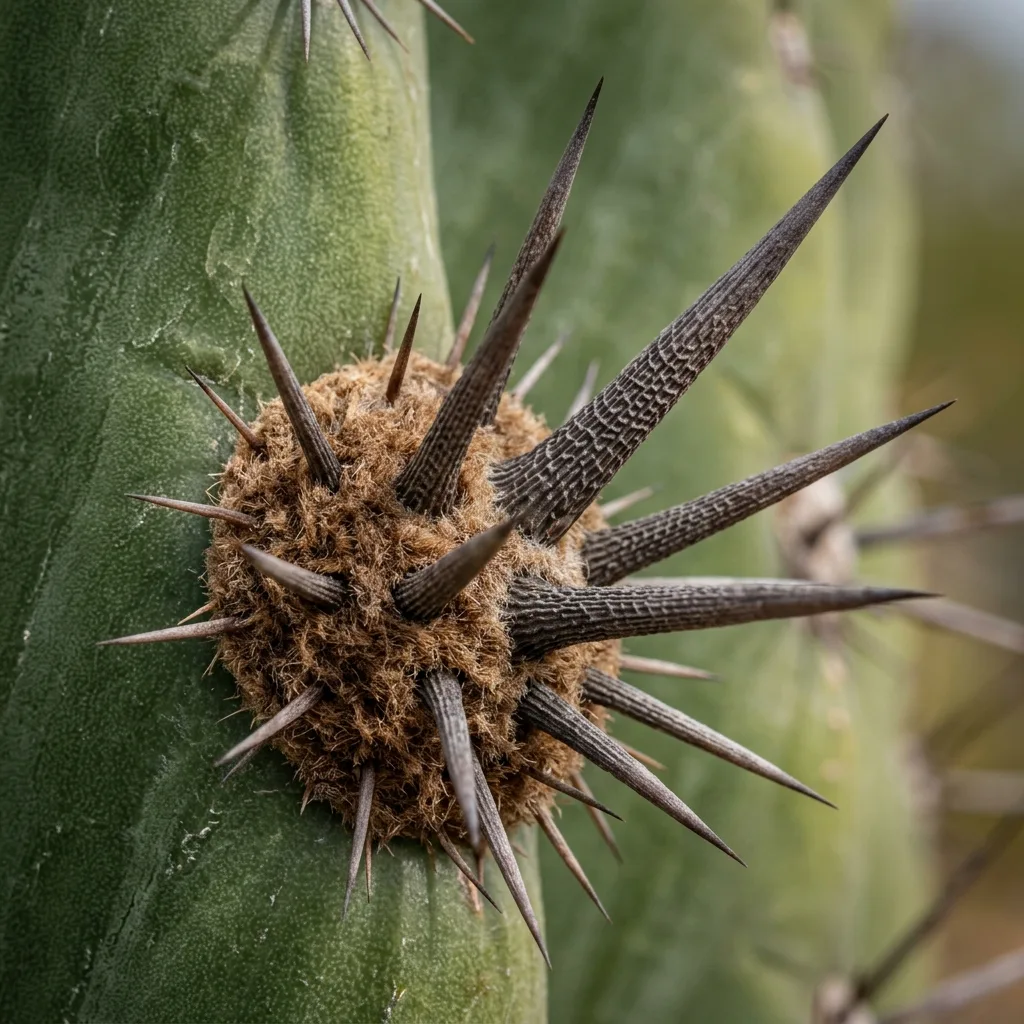
Arranged along the rib crests are the areoles—highly specialized, modified bud structures cushioned in dense, brownish-gray felted trichomes. Emerging from each areole are 15 to 30 rigid radial and central spines. Beyond serving as mechanical deterrences against foraging herbivores, these spines create micro-shading lattices that measurably lower stem surface temperatures and disrupt desiccating desert winds sweeping across the epidermis. Their matte gray-brown hue serves as an organic sun shield, deflecting intense ultraviolet radiation away from delicate chlorophyll cells beneath.
2. Light Requisites, Solar Intensity, and Ventilation Protocols
Originating from one of the sun-drenched epicenters of the globe, Carnegiea gigantea cannot sustain life without high-intensity illumination. Yet here lies a subtle ecological paradox: in the wild, tiny Saguaro seedlings almost invariably germinate under the canopy of a 'nurse tree,' such as Parkinsonia microphylla (Palo Verde) or low-lying desert scrub. Consequently, exposing an unprotected 2-to-3-year-old potted seedling directly to blazing midsummer sun behind an unvented south-facing window pane can cause photobleaching, causing epidermal cells to lose chlorophyll and sustain irreversible, scarred solar scorching.
The optimal lighting protocol entails delivering a minimum of 6 to 8 hours of brilliant, bright indirect sun or gentle, direct morning and late-afternoon exposure daily. As the plant expands its cuticle and thickens its spines, its tolerance for direct, full-spectrum sun increases exponentially. Indoors, an unobstructed south-facing window is non-negotiable; in lower light, the stem will suffer from etiolation—thinning out, losing its deep blue-green pigmentation, and irreparably destabilizing its majestic columnar equilibrium. Dynamic atmospheric ventilation is equally vital: stagnant, humid air remains the swiftest catalyst for fungal blight in desert succulents.
3. Hydration Cycles and the Vital Winter Dormancy Protocol
The internal water management of the Saguaro is anchored in CAM (Crassulacean Acid Metabolism) photosynthesis. The plant keeps its stomata hermetically sealed throughout the blistering daylight hours to prevent transpirational moisture loss, opening them exclusively during cooler desert nights to capture and chemically fix carbon dioxide into organic acids. This biochemical mastery reduces cellular water expenditure to near-zero levels. During its active growth phase from mid-spring to early autumn, hydrate utilizing the strict 'soak and dry' philosophy—saturate the root ball thoroughly, and allow the potting medium to desiccate completely before reapplying water.
Winter dormancy constitutes the bedrock of sustained Saguaro vigor. As diurnal temperatures dip below 12–15°C (54–59°F), the specimen reduces its metabolic activity to an absolute baseline. From late autumn through late winter, irrigation must cease almost completely.
4. High-Mineral Granular Substrates and Container Physics
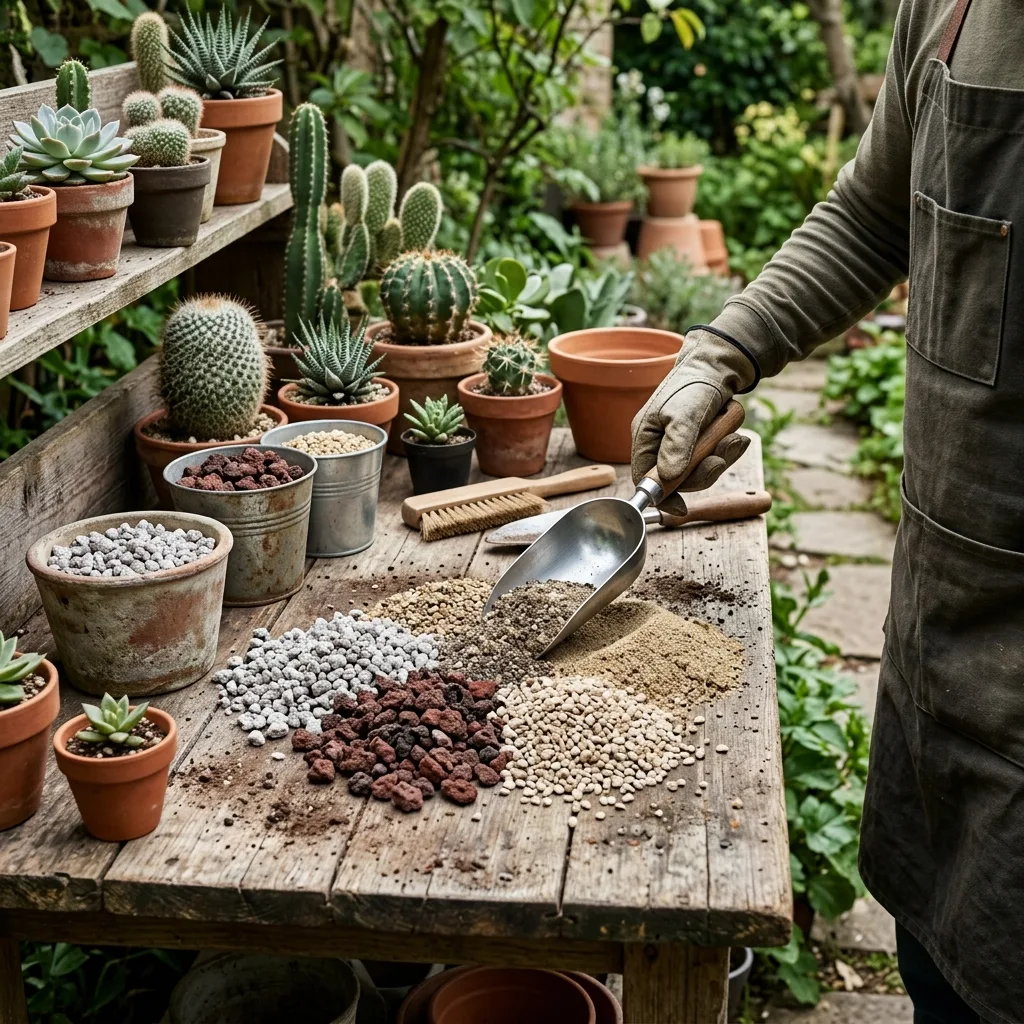
In its native habitat, Saguaro root systems anchor tenaciously into decomposed granite fissures, volcanic alluvial washes, and calcareous clays. Standard commercial peat-based potting soils act as moist sponges that swiftly suffocate the root cortex. To mirror native pedology, your container mix must be ultra-porous, predominantly inorganic, and formulated to evacuate gravitational water through bottom drainage holes in a matter of seconds.
Always select unglazed, breathable terracotta containers over synthetic plastic or glazed ceramic alternatives. Unglazed clay walls allow gaseous exchange through their porous structure and encourage even evaporation. Furthermore, adjust the container volume strictly to the current root profile; overpotting into massive volumes introduces wet, uncolonized soil dead zones that foster opportunistic microbial pathogens.
| Substrate Component | Recommended Ratio (%) | Functional & Botanical Advantage |
|---|---|---|
| Pumice (Ponza Stone) | 30% | Buffers excess moisture, releases it gradually, and guarantees root aeration. |
| Crushed Lava Rock (Scoria) | 30% | Provides permanent macropores, structural stability, and trace mineral ions. |
| Coarse Quartz Sand / Zeolite | 20% | Maintains grit integrity, anchors the heavy stem, and prevents compaction. |
| Sifted Peat or Sterilized Leaf Mold | 20% | Provides minimal organic cation exchange capacity for initial root engagement. |
5. Flowering Realities and Targeted Nutrition
Anticipating blooms on an indoor Saguaro requires cosmic patience: in nature, this columnar monarch does not produce its nocturnal, creamy-white blossoms—pollinated by desert nectar bats and migratory doves—until it attains roughly 35 to 50 years of age and standing height. Nevertheless, applying targeted nutritional inputs preserves the metabolic vigor and spine mineralization of juvenile specimens.
During active spring and summer elongation (May through August), feed monthly with a specialized, low-nitrogen, high-potassium, and phosphorus fertilizer (such as an NPK 4-10-10 or 5-10-10 blend), diluted to one-quarter the manufacturer's suggested strength. High-nitrogen formulations must be avoided at all costs; they force uncharacteristically rapid, thin epidermal expansion, leaving the ribbed stem vulnerable to transverse splitting, micro-cracks, and subsequent bacterial infiltration.
6. Propagation, Seedling Husbandry, and Micro-Grafting
Propagating Carnegiea gigantea is almost exclusively executed via botanical seeds. Given that wild specimens take multiple generations to produce basal branches, harvesting vegetative stem cuttings is neither biologically practical nor ecologically viable. For cultivators venturing to raise Saguaros from seed, the standard protocol includes:
- Sow seeds across a leveled, highly mineralized, pre-moistened seed substrate. Press them delicately onto the surface without burying them, as light exposure triggers the germination response.
- Seal the seed tray within a transparent germination dome to maintain elevated relative humidity, keeping ambient temperatures between 24°C and 28°C (75–82°F) under bright, indirect light.
- Germination unfolds over 10 to 20 days. Once the microscopic, rounded green spheroids develop their first proto-spines, gradually introduce air vents to lower humidity and harden the seedlings.
Advanced collectors looking to accelerate juvenile growth rates occasionally employ micro-grafting, transferring tiny young Saguaro seedlings onto vigorous, fast-growing columnar rootstocks like Trichocereus or Myrtillocactus geometrizans. While this technique can accelerate vegetative expansion by five to tenfold, it often alters the naturally compressed, dense spine spacing of an authentic desert-grown specimen.
7. Mitigating Rot, Pathogens, and Insect Pressures
The single most catastrophic affliction threatening an indoor Saguaro is wet basal stem rot induced by opportunistic fungal pathogens such as Fusarium or Phytophthora species. If the lower stem adjacent to the soil surface becomes soft, turns translucent yellow-brown, and yields to gentle finger pressure, the crisis is systemic. Immediately unpot the cactus and wash the root system. Using a sterile razor blade, excise all decayed tissue until only pristine, unblemished green and white vascular bundles remain. Dust the cut surface liberally with elemental sulfur powder or powdered cinnamon, allow a robust, dry callus to form in a dry, shaded room for 10 to 14 days, and re-pot into completely bone-dry mineral grit.
Insect infestations typically manifest as mealybugs nestled deeply within the felted areoles or cryptic spider mites scraping the epidermal cuticle in stagnant, dry air. Periodically inspect the rib valleys with a loupe. Address isolated colonies mechanically using a cotton swab dipped in 70% isopropyl alcohol, or mist with a cold-pressed horticultural neem emulsion during twilight hours to avoid phytotoxic sun scorching.


Reader Reviews & Comments 3 Reviews
Julian Vance
Clara Higgins
Marcus Sterling
Leave a Review & Rating
Share your plant care tips, experiences, or questions with our succulent community.