






Perched upon bare granite and gneiss outcroppings across the central highland plateaus of Madagascar, a mesmerizing living organism blends seamlessly into the landscape, appearing at first glance to be nothing more than an inert slab of weathered stone. Hugging the bedrock with a flattened, silvery-grey stem, Pachypodium brevicaule represents one of nature's most audacious adaptations to drought: a dwarf caudiciform succulent built to withstand fierce sun and brutal dry seasons. In early spring, when brilliant canary-yellow blossoms erupt from the fissures of this stony mass, it resembles an undeniable botanical miracle bursting directly out of bedrock.
Long regarded as the holy grail among dedicated succulent and caudiciform collectors, this species demands deep respect, horticultural intuition, and unyielding discipline in cultivation. Because of its extremely delicate root architecture and the massive volume of water stored within its central reservoir, approaching it with conventional houseplant care routines will almost certainly lead to swift heartbreak. However, once you recreate the high-elevation wind currents, relentless solar radiation, and well-defined dry resting cycles of its ancestral home, you will be rewarded with a living, sculptural work of art capable of gracing your collection for decades.
1. Botanical Identity and Morphological Adaptations
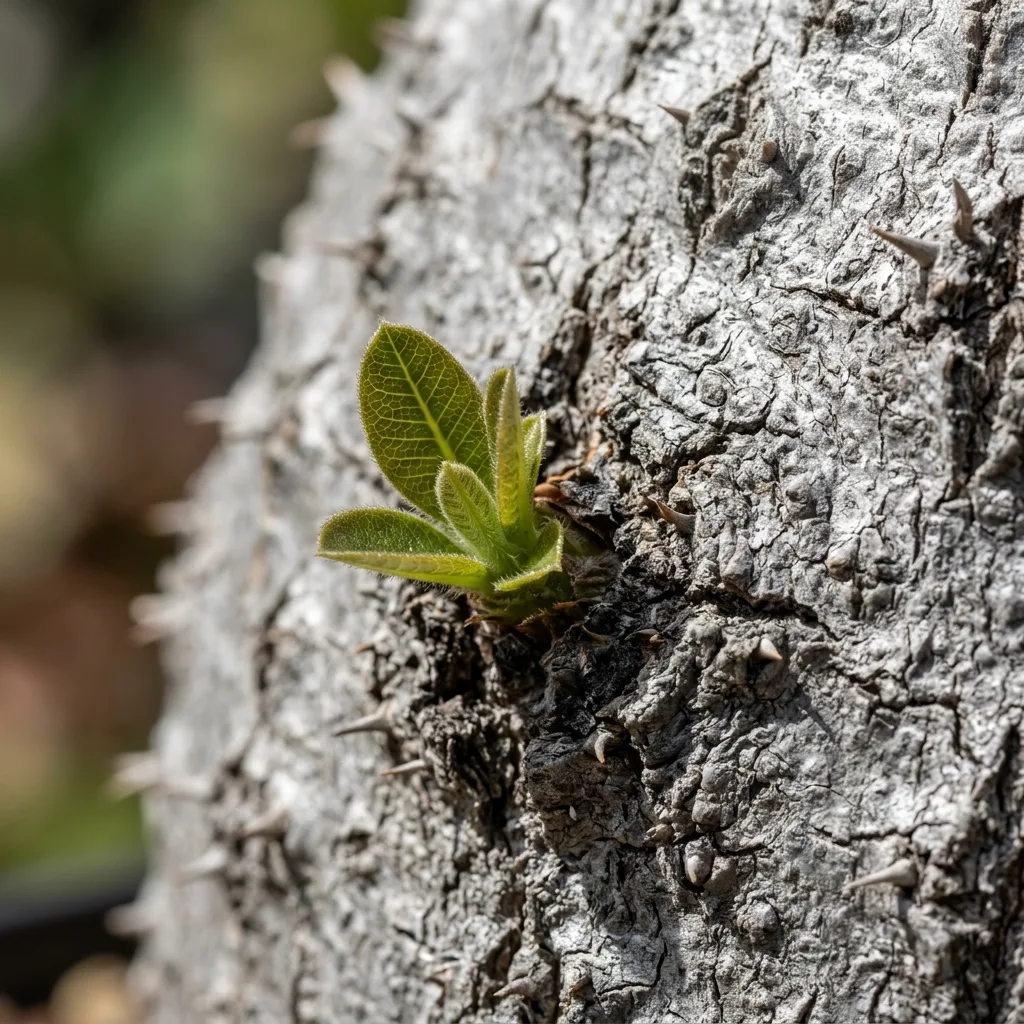
A distinguished member of the dogbane family (Apocynaceae), Pachypodium brevicaule derives its specific epithet from Latin, translating literally to 'short-stemmed.' Rather than sending up an erect, spiny column like many of its continental African and Madagascan relatives, this species expands horizontally, forming a massive, flattened, smooth-to-tuberculate caudex shaded in tones of weathered silver, pewter, and bronze. While mature wild specimens can spread up to 60 centimeters in diameter, they rarely exceed 10 to 15 centimeters in total height.
From miniature conical nodes scattered across the caudex emerge tight rosettes of deciduous, elliptic, dark green leaves coated with minute micro-hairs that reduce transpirational moisture loss. At the base of each leaf cluster sit pairs of small, modified spines. To flourish in harsh habitats, the plant utilizes Crassulacean Acid Metabolism (CAM photosynthesis), keeping its stomata tightly sealed during blazing daylight hours to prevent desiccation and opening them during cool night cycles to sequester carbon dioxide. In early spring, trumpet-shaped yellow flowers with delicate petals bloom on short peduncles, creating a dramatic, poetically striking contrast against the massive, monolithic stone-like body.
2. Light Requirements and Indoor Positioning
Hailing from Madagascar's mist-bathed yet intensely luminous plateaus at altitudes between 1,500 and 2,000 meters, this succulent possesses a profound photon hunger. Under inadequate lighting, its cellular turgor softens, its silvery epidermis fades to an unhealthy dull green, and the caudex loses its characteristic density, quickly leaving the plant vulnerable to opportunistic fungal pathogens.
When cultivated indoors, position your plant on the sunniest, most unobstructed south- or west-facing windowsill available. It requires a minimum of 5 to 6 hours of direct, unfiltered solar radiation daily to maintain an ultra-compact, rock-hard silhouette. During the peak of summer, beware of extreme greenhouse heat trapped behind unvented windowpanes; active air movement is mandatory, as stagnant, sweltering air can literally parboil the tender root hairs within an overheated pot.
3. Watering Discipline: The 'Soak and Complete Dry-Out' Protocol
The swiftest and most common way to kill Pachypodium brevicaule is through the well-intentioned error of light, frequent watering. Dribbling small amounts of water over the soil every few days is not kindness; it starves root tissues of vital oxygen and invites anaerobic decay. This species is biologically engineered to withstand months of drought, sequestering substantial water reserves deep inside its parenchymal storage tissues.
During its active growth window from late spring through early autumn, apply the rigorous 'soak and complete dry-out' protocol. Water the substrate thoroughly until moisture streams freely from the drainage holes, empty the runoff tray immediately so the roots never sit in standing water, and withhold all moisture until the substrate has dried out entirely to the bottom of the container. A gentle squeeze at the outer margin of the caudex serves as your most dependable physiological gauge: a subtle, supple 'give' indicates depleted water reserves, signaling that the plant is genuinely ready for a deep drench.
4. Substrate Engineering and Pot Selection
In its native range, Pachypodium brevicaule anchors itself exclusively into acidic sandstone grit and quartzite crevices. Consequently, it will not survive in peat-heavy, moisture-retentive commercial potting soils. Its fragile xylem and root hairs demand constant atmospheric exchange; thus, a gritty, highly porous, predominantly mineral substrate is non-negotiable.
Container selection is equally vital. Avoid deep, standard pots in favor of shallow, wide terracotta bowls that accommodate the plant's spreading, superficial root architecture. Unglazed terracotta allows ambient evaporation through its clay micropores, cooling root zones and reducing the risk of root rot by more than half compared to glazed ceramic or plastic vessels.
| Substrate Component | Ratio (%) | Horticultural Function and Physiological Benefit |
|---|---|---|
| Horticultural Pumice (3–6 mm) | 40% | Provides superior porosity, maintains structural air channels, and prevents soil compaction. |
| Crushed Lava Rock (Scoria) | 25% | Delivers rapid drainage, structural weight, and trace mineral supplementation. |
| Zeolite or Hard Akadama | 15% | Enhances Cation Exchange Capacity (CEC), buffers nutrients, and regulates moisture balance. |
| Coarse Quartz Sand / Fine Grit | 10% | Replicates natural granitic scree and ensures rapid drainage around the delicate root collar. |
| Sifted Horticultural Peat / Coir | 10% | Supplies a minimal organic base while buffering the substrate to a slightly acidic pH. |

5. Step-by-Step Propagation Techniques
Multiplying Pachypodium brevicaule is predominantly achieved through two distinct approaches: growing from seed to preserve natural morphology, or grafting onto a vigorous rootstock for enhanced resilience and accelerated growth.
- Propagation from Seed: The Art of Succulent Kokedama: Living Moss Ball Crafting and Care Guide">The Art of Scientific Stem Cuttings and Rooting">This is the purest, most rewarding, yet patience-testing method. Soak fresh, viable seeds in lukewarm distilled water for 12 hours, then sow them surface-level on a sterilized, fine mineral mix. Maintain a temperature of 25–28°C under gentle humidity; germination typically occurs within 7 to 14 days. While young seedlings require moderate humidity during their initial six months, constant ventilation is imperative to ward off damping-off fungi.
- Grafting (Top-Working): Because own-root specimens grow agonizingly slowly and remain notoriously susceptible to rot, commercial growers frequently graft scions onto hardier, fast-growing congeners such as Pachypodium lamerei or Pachypodium geayi. Using a razor-sharp, sterilized scalpel, perform an even flat graft between the seedling scion and the decapitated rootstock, securing them firmly with silicone grafting bands until vascular cambium union is achieved.
6. Common Pathogens, Pest Pressures, and Interventions
Without question, the foremost threat to this plant in home cultivation is 'pathogenic over-care'—overwatering that triggers devastating root and basal caudex rot caused by Fusarium and Phytophthora species. If the lower margin of the caudex turns dark brown, collapses inward, or develops a spongy, waterlogged consistency, rot has penetrated the vascular tissue. If detected early, you must perform emergency surgery: excise every millimeter of infected tissue with a sterilized blade until clean, pristine white parenchyma remains, seal the exposed wound with sulfur powder, and keep the plant bone-dry in bright shade for several weeks to callus.
Regarding insect pests, dry indoor winter air frequently encourages red spider mites (Tetranychidae), which cluster on the undersides of leaves, causing silver stippling. Mealybugs can also lodge themselves within the tight fissures of the caudex. Treat mealybugs individually with cotton swabs dipped in 70% isopropyl alcohol; manage wider mite infestations with cold-pressed neem oil formulations applied strictly during low-light hours to prevent leaf scorching.
7. The Seasonal Care Calendar: Expert Rhythm
Spring (Awakening): As April approaches and ambient daytime temperatures stabilize consistently above 18°C, the caudex stirs from rest. When the first green leaf tips erupt from the crown, resume watering with a light, warm soak. You may introduce a specialized low-nitrogen, high-potassium cactus fertilizer diluted to one-quarter strength with the second watering of the season.
Summer (Active Vegetative Growth): Provide the plant with full sun and vigorous air movement on a protected terrace or sunny south ledge. Water deeply whenever the mineral mix dries out completely. Take note: during blistering heatwaves exceeding 35°C, the plant may enter a brief, protective semi-dormancy; slightly moderate your watering frequency during such spells.
Autumn (Hardening Off): Beginning in late September, lengthen the intervals between waterings. As ambient temperatures drop in October and November, foliage will naturally turn amber and drop. Halt all supplemental feeding, withdraw moisture, and allow the caudex tissues to firm up and prepare for cellular cold-tolerance.
Winter (Deep Dormancy): Keep the leafless plant completely dry in a bright, sunlit room where temperatures remain reliably between 12°C and 16°C (never let it drop below 10°C). Shield the dormant caudex from icy drafts, cold window condensation, and damp substrate at all costs.


Reader Reviews & Comments 3 Reviews
Julian Vance
Marcus Thorne
Eleanor Campbell
Leave a Review & Rating
Share your plant care tips, experiences, or questions with our succulent community.