






Picture a rugged Ferocactus wedged between sun-scorched rock fissures in the Sonoran Desert, thriving for months without a single drop of rain, or a resilient Copiapoa anchoring the hyper-arid plateaus of the Atacama, drinking exclusively from ephemeral morning sea fog. When these architectural marvels grace our indoor windowsills, their evolutionary physiology remains completely unchanged. Yet the moment a plant enthusiast stands before a cactus with a watering can in hand, asking, 'How often should I actually water this?', they are stepping onto the threshold of a profound botanical journey.
Within the world of succulents and cacti, a persistent, catastrophic misconception reigns: 'water once every Sunday' or 'give it a single teaspoon of water once a month.' In biological reality, a cactus's vascular system does not operate on an arbitrary human calendar; it responds dynamically to intracellular water potential, ambient temperature, photoperiod intensity, and substrate porosity. Drenching a cactus at rigid, frequent intervals is not an act of love—it suffocates the subterranean root hairs, quietly drowning the plant from below. Let us demystify your green companion's hydration cues and master its ideal seasonal rhythm, from crown to root tip.
1. Taxonomic Identity, Areole Structure, and Spine Morphology
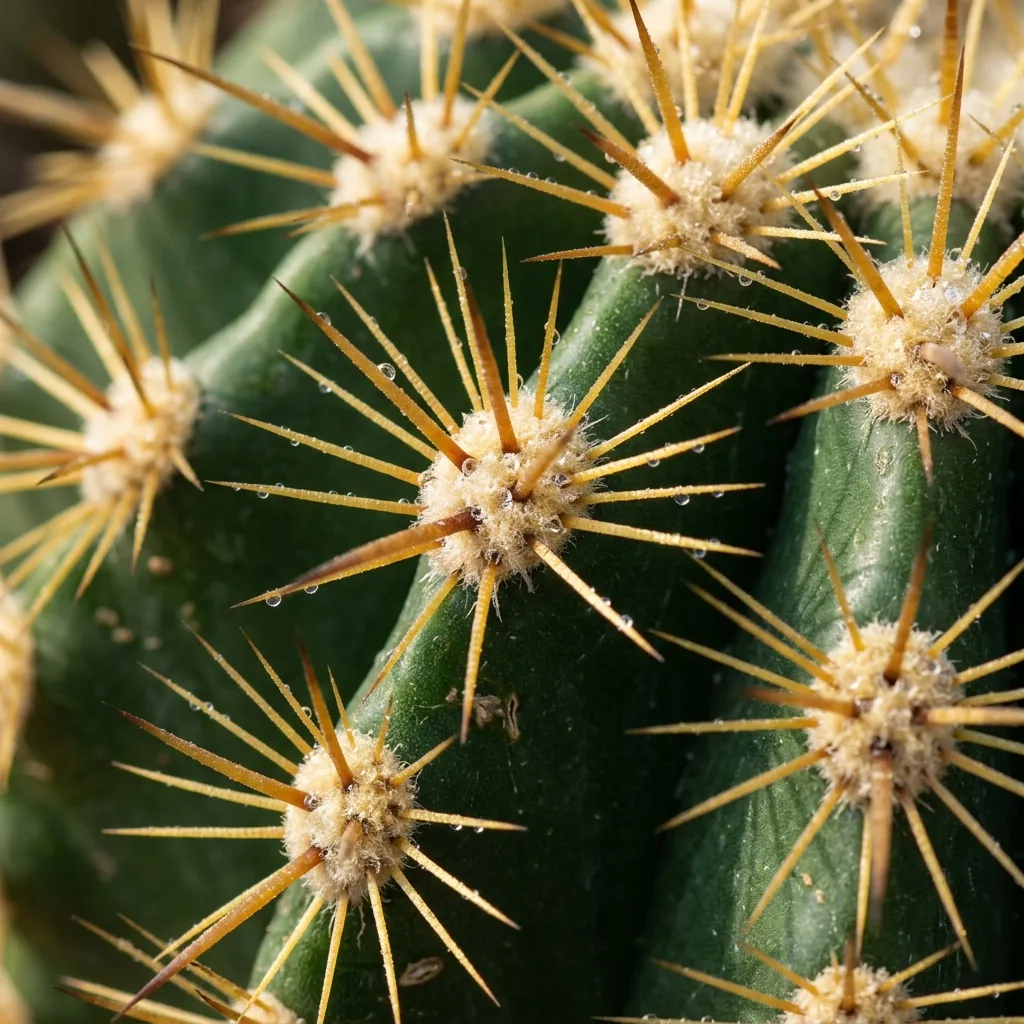
The definitive morphological hallmark that distinguishes true cacti (family Cactaceae) from all other convergent succulent forms is the presence of areoles. Areoles are specialized, highly condensed, cushion-like meristematic nodes distributed across the stem tissue, serving as the distinct evolutionary epicenter from which spines, glochids, floral buds, and lateral offsets erupt. If a succulent bears thorns emerging directly from its dermal stem tissue (as seen in succulent Euphorbia species), it is not a cactus; if those defensive armatures arise from a distinct areolar pad, you are unquestionably caring for a botanical cactus.
Cactus spines are far more than a defensive deterrent against desert herbivores. Functioning as evolutionarily modified, non-photosynthetic leaves, these micro-structures create a protective microclimatic 'boundary layer' around the epidermis, substantially baffling desiccating desert winds and decelerating transpiration. Furthermore, their radial and central geometric alignment casts micro-shadows across the stem, mitigating intense solar radiation, while channeling condensed atmospheric dew straight down into the stem cortex via capillary action. Complementing this, deep accordion-like vertical ribs allow the cellular volume of the stem to expand rapidly during flash deluges and safely contract during prolonged drought without tearing the cuticle.
2. Light Intensity, Solar Requirements, and Aeration Standards
The most decisive environmental driver of hydration frequency is direct, high-lumen light exposure paired with adequate air circulation. Cacti conduct an evolutionary marvel of bioenergetics known as Crassulacean Acid Metabolism (CAM). To minimize transpirational moisture loss, their microscopic stomata stay sealed shut during blazing daytime hours, opening exclusively in the cooler night air to sequester ambient carbon dioxide and convert it into malic acid. For this complex biochemical cascade to operate efficiently, cacti require a minimum of 4 to 6 hours of direct, unfiltered solar radiation each day.
A cactus kept in sub-par lighting will rapidly undergo etiolation—stretching out into pale, attenuated, structurally compromised growth. Under photon deficiency, metabolic activity stalls, causing root water uptake to plummet to near zero. A doused root ball in such stagnant conditions turns the potting media into an anaerobic breeding ground for fungal pathogens within 48 to 72 hours. To maintain a safe and vigorous watering cycle, cacti demand bright, well-ventilated settings that actively prevent stale, humid air pockets around the stem base.
3. The Seasonal Hydration Cycle and Critical Winter Dormancy
The question 'How often should you water a cactus?' has no monolithic, static answer; seasonal rhythms dictate biological demand. The cornerstone rule of cactus hydration is the 'Soak and Dry' protocol. When you water, thoroughly saturate the root zone until water flows freely from the drainage holes, but do not provide another drop until the deepest core of the potting mix is dry as a bone.
- Spring (March – May): Cellular growth awakens. Depending on ambient temperatures, a thorough watering every 10 to 14 days is generally ideal.
- Summer (June – August): The metabolic peak of the growth season. High evapotranspiration rates typically necessitate watering every 7 to 10 days for indoor specimens, or every 5 to 7 days for outdoor collection plants exposed to summer breezes and heat.
- Autumn (September – October): As daylight hours dwindle and night temperatures drop, space waterings to every 15 to 20 days while scaling down water volumes.
- Winter (November – February): A profound period of dormancy for desert cacti. Maintained in a cool, bright location (8–12°C / 46–54°F), cacti require virtually no water (a light splash every 6 to 8 weeks simply to keep root fibrils from desiccating completely). If overwintered in a heated, warm living room, verify total soil dryness and water sparingly every 3 to 4 weeks at most.
4. High-Mineral Substrates and Container Physics
The temporal frequency of your watering routine is inextricably linked to the physical porosity of your growing medium. Commercial, peat-heavy potting mixes act like dense sponges, retaining water for weeks and establishing a lethal, hypoxic suffocating trap for desert root architectures. Cactus root systems do not crave rich, decomposed organic humus; they demand high-porosity volcanic gravel blends that drain in seconds while preserving vital subterranean oxygen pockets.
Container composition plays an equally pivotal role. Unfinished, porous terracotta pots act as natural evaporative cooling vessels, wicking surplus moisture sideways through their clay walls and drastically curbing root rot risks. In contrast, glazed ceramic, sealed resin, or plastic pots lock moisture inside, demanding significantly longer waiting intervals between each irrigation cycle.
| Substrate Component | Specific Material | Ratio (%) | Botanical Functionality |
|---|---|---|---|
| Inorganic Mineral | Horticultural Pumice (3–6mm) | 40% | Maintains macro-aeration pockets, prevents compaction, facilitates instant drainage. |
| Inorganic Mineral | Crushed Lava Rock & Zeolite Mix | 30% | Supplies structural grit, traces of micronutrients, and swiftly wicks excess water. |
| Organic Component | Sieved Coarse Coco Coir | 20% | Provides clean, pathogen-free structural fiber for fine root anchorage without souring. |
| Inorganic Grit | Coarse Quartz Grit / River Sand | 10% | Enhances ballast, structural friction, and long-term drainage pathway stability. |

5. Inducing Vibrant Blooms and Fertilizer Chemistry
Many indoor gardeners resign themselves to the idea that cacti are merely stoic, spiny green sculptures incapable of blooming indoors. However, floral induction in desert cacti is a direct physiological consequence of strategic winter dormancy coupled with strict drought stress. When subjected to a chilling, dry dormancy at 8–10°C (46–50°F) through winter, specific endogenous stress phytohormones trigger generative floral bud differentiation within the areoles. Come spring, rising solar thermals coupled with your first warm, deep soak signal the arrival of spring, triggering an explosive flush of dazzling blossoms.
Nutritional supplements must be reserved exclusively for the active growth window of spring and early summer. Seek out specialized, low-nitrogen, high-potassium, and phosphorus liquid formulations (such as an NPK 5-10-10 or 4-8-12 ratio). High nitrogen causes rapid, bloated cellular walls that invite fungal ruptures. Always dilute liquid fertilizer to half or quarter strength, applying it no more than once a month with irrigation water. Never fertilize a dormant or bone-dry cactus.
6. Propagation, Callusing, and Grafting Dynamics
Hydration precision becomes critically unforgiving when propagating cacti. If an offset (pup) or stem cutting is severed from the mother plant and immediately seated into moist soil, soil-borne bacteria and fungi will invade the open wound, turning the specimen into black mush within days. Following a clean incision, the cutting must rest in an arid, brightly lit, well-ventilated spot for 4 to 10 days until a tough, woody protective callus seals the wound margins completely.
Once callused, seat the cutting upon dry, gritty mineral medium. Do not pour heavy water; supply only an occasional basal misting along the top grit until adventitious root initials develop (typically 2 to 4 weeks). In the case of chlorophyll-deficient mutated cacti (such as bright neon pink or yellow Gymnocalycium mihanovichii forma rubra), propagation requires apical grafting. These mutants rely completely on a robust, green rootstock—most commonly Hylocereus undatus—by precisely aligning their respective vascular rings (cambium layers) under firm, localized tension.
7. Defending Against Fungal Pathogens and Basal Rot
The earliest physiological symptom of chronic overwatering is a dulling of the epidermis, followed by an ominous translucence near the root collar and a spongy, waterlogged feel when gently prodded with a blunt instrument. Soil-dwelling fungal pathogens like Phytophthora cactorum and Fusarium oxysporum exploit hypoxic root tips, moving swiftly through xylem and phloem vessels to disintegrate inner parenchymal tissue from within.
Conversely, an under-watered cactus will draw upon its water-storage parenchyma, visibly shrinking, deepening its rib folds, and developing slight vertical wrinkles. Under-watering is rarely fatal; a single thorough soak usually restores full turgor pressure within 24 to 48 hours. Overwatering, on the other hand, leaves virtually no margin for botanical error.


Reader Reviews & Comments 3 Reviews
Arthur Pendelton
Clara Higgins
Marcus Vance
Leave a Review & Rating
Share your plant care tips, experiences, or questions with our succulent community.