






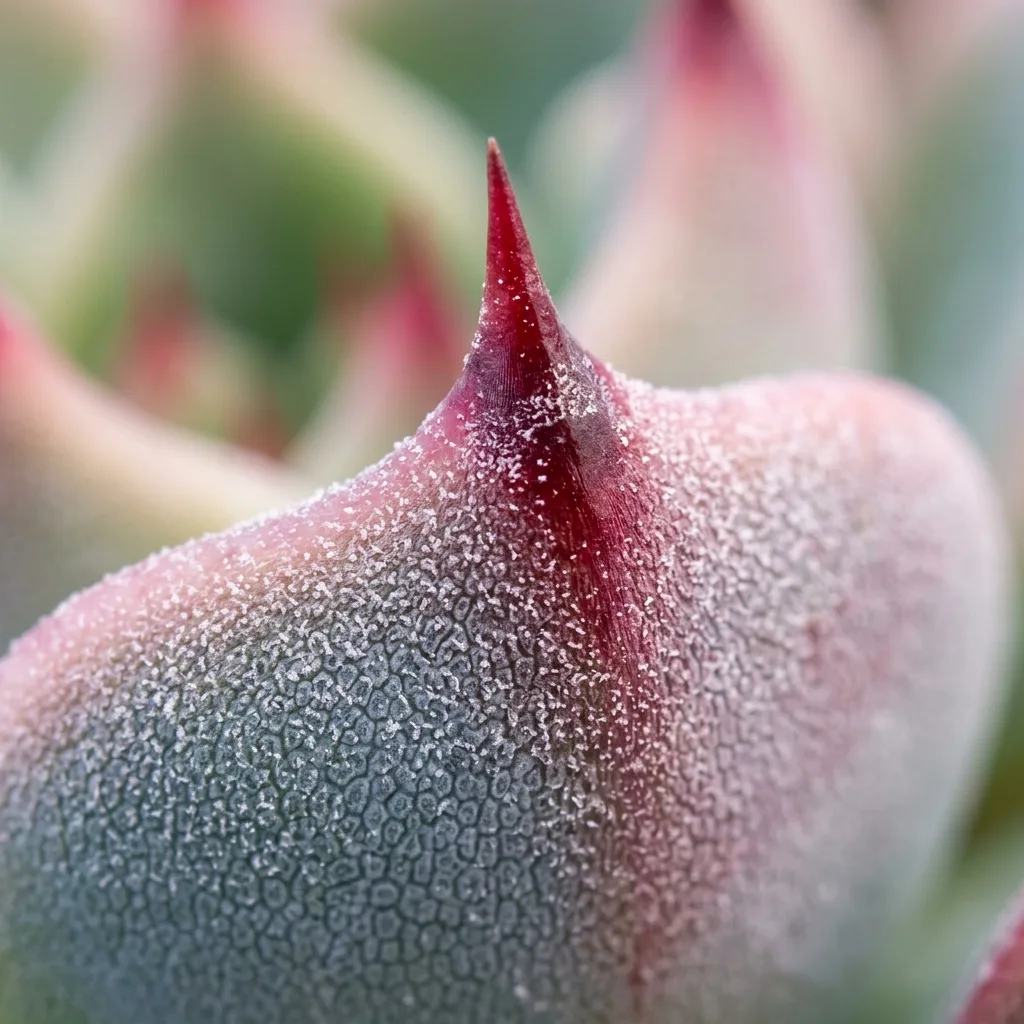
One of the most delicate and compact gems of the succulent world, Echeveria 'Nobaranosei' (a hybrid of Echeveria cuspidata var. zaragozae x Echeveria minima) is celebrated for its sharp, dark red terminal spines and powdery epicuticular farina. Behind this aesthetic wonder, however, lies an anatomical root architecture with an exceptional hunger for oxygen. Succulent roots are not merely passive conduits for water absorption; they rely directly on free gaseous oxygen (O₂) trapped within porous substrate voids to perform cellular respiration and sustain the energetic demands of Crassulacean Acid Metabolism (CAM).
When dense garden soils or standard peat-based potting mixes are saturated, microscopic pores are instantly choked by water films. This creates an anaerobic microclimate in the rhizosphere (root zone) within minutes. Deprived of oxygen, Echeveria 'Nobaranosei' root cells are forced to shut down the mitochondrial electron transport chain, shifting into anaerobic fermentation that leads to an accumulation of toxic ethanol and lactic acid within root tissues. The inevitable consequence is cellular membrane lysis followed by rapid root rot driven by opportunistic fungal pathogens such as Pythium and Fusarium. The cardinal rule of growing a flourishing 'Nobaranosei' is configuring drainage not just as water egress, but as instantaneous post-watering gas diffusion that refills root cavities with fresh air.
1. Comparative Analysis of Inorganic Mineral Aggregates
Inorganic aggregates must constitute the structural framework of any specialized succulent substrate. These mineral components resist physical decomposition, maintain structural porosity for years, and minimize capillary water retention by facilitating gravitational drainage. For species with fine, sensitive root systems like Echeveria 'Nobaranosei', the particle size distribution (granulometry) must be strictly calibrated between 2 mm and 5 mm.
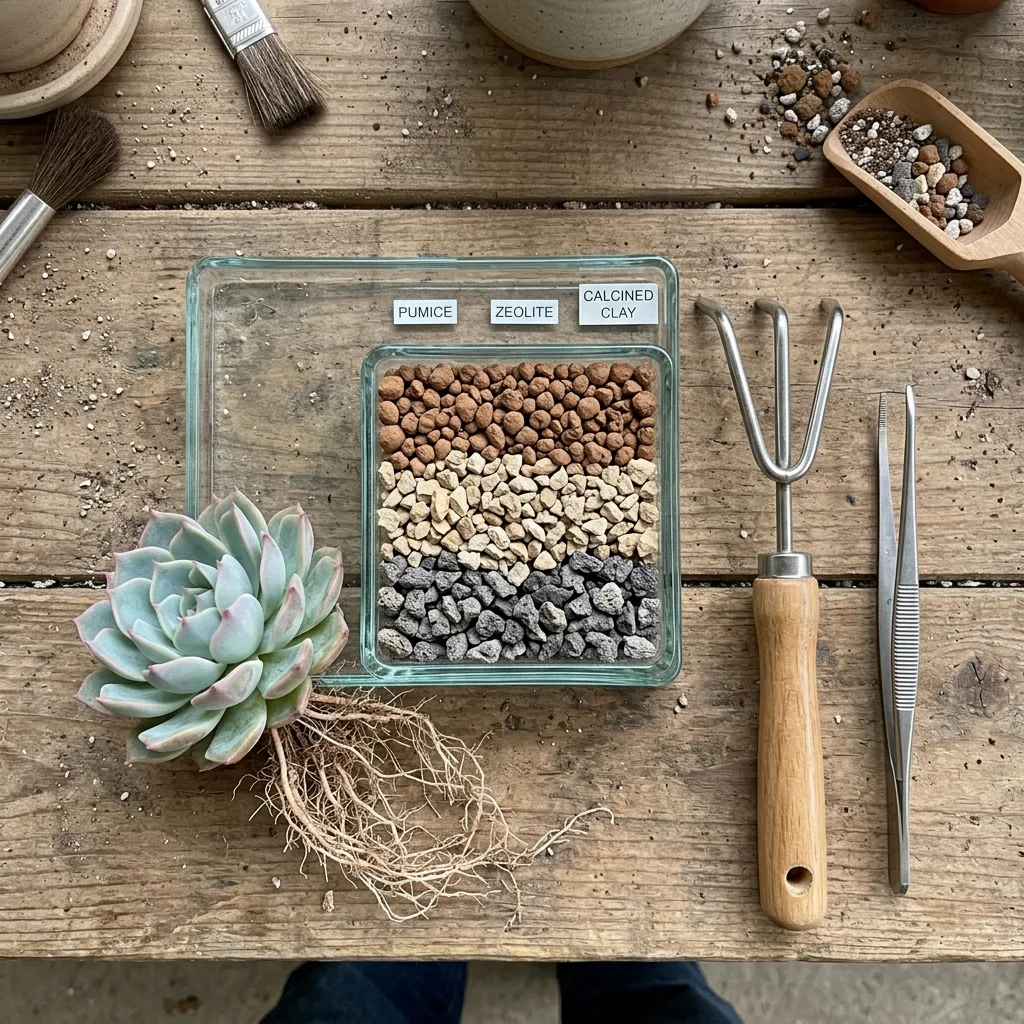
- Pumice: A volcanic, highly porous rock characterized by interconnected open micropores. Pumice holds water via surface tension while preserving internal trapped air pockets. It is chemically neutral (pH 6.8–7.2) and provides an abrasive, micro-fractured surface to which root hairs can firmly anchor.
- Lava Rock (Scoria): Also of volcanic origin, scoria is denser and rich in iron and magnesium oxides. Its sharp, angular geometry prevents root circling within the pot, stimulating secondary root branching. It also adds ballast, preventing lightweight pots from tipping over.
- Zeolite (Clinoptilolite Form): Featuring a unique negatively charged aluminosilicate lattice, zeolite boasts an exceptional Cation Exchange Capacity (CEC). It binds vital potassium (K+), calcium (Ca2+), and ammonium ions, releasing them gradually along an osmotic gradient only when root exudates signal demand. Furthermore, it filters the rhizosphere by absorbing waterborne chlorine compounds.
- Calcined Clay (Akadama & Expanded Clay): High-temperature baked clay granules deliver soft micro-drainage and gentle contact for fragile root tips. However, substandard akadama breaks down into mush within 1–2 years; therefore, only hard-fired ('hard grade') akadama should be utilized for 'Nobaranosei'.
- Perlite: While ubiquitous, perlite is excessively light and floats to the top during bottom-watering or heavy drenching. Its dust is an inhalation irritant, and its brittle particles crush easily under root pressure. It remains an inferior alternative when pumice is available.
2. Organic Matter Balance: Peat, Coco Coir, and Compost
Despite the dominance of mineral aggregates, Echeveria 'Nobaranosei' cannot thrive in pure, sterile stone without a minimal organic matrix to facilitate micronutrient cycling and moisture bridging. However, this organic ratio must remain strictly controlled.
Blonde Sphagnum Peat: Fibrous and airy, its mildly acidic profile (pH 5.5–6.0) mirrors the natural rocky crags inhabited by ancestral Echeverias. Nonetheless, once peat dries out completely, it becomes intensely hydrophobic, refusing to rehydrate unless subjected to prolonged bottom-soaking.
Coco Coir: A sustainable alternative to peat, coco coir rehydrates effortlessly after complete desiccation and features high lignin content, making it far slower to decompose. However, agricultural coir bricks frequently contain high residual sea salts (sodium chloride). Ensure you procure 'washed, low-EC (electrical conductivity)' coco coir to safeguard root hairs.
Worm Castings: If included as the organic fraction, keep worm castings capped at 3–5% of the total volume. They serve as a potent bio-inoculant loaded with beneficial microflora and natural auxins/cytokinins for root elongation. Ordinary garden compost or unaged farm manure is lethal to 'Nobaranosei', as both release excess ammonia and harbor root-rot pathogens.
3. Customized Substrate Formulations Across Succulent Genera
Not all succulents share the exact same rhizosphere hydration tolerance. The table below standardizes substrate ratios and particle sizing, centered around Echeveria 'Nobaranosei':
| Plant Group / Species | Inorganic % | Organic % | Recommended Mineral Composition | Optimal Grain Size |
|---|---|---|---|---|
| Echeveria 'Nobaranosei' | 70% – 80% | 20% – 30% | 35% Pumice + 20% Zeolite + 15% Lava Rock + 25% Sifted Coco Coir/Peat + 5% Worm Castings | 2 – 4 mm |
| Haworthia & Gasteria | 60% | 40% | 30% Pumice + 20% Hard Akadama + 10% Zeolite + 40% Fibrous Sphagnum Peat | 3 – 5 mm (For fleshy roots) |
| Desert Cacti (Echinopsis, etc.) | 85% – 90% | 10% – 15% | 40% Pumice + 30% Scoria + 15% Zeolite + 15% Fine Peat / Coarse Sand | 2 – 6 mm |
| Lithops & Mesembs | 90% – 95% | 5% – 10% | 50% Fine Pumice + 25% Zeolite + 20% Quartz Grit + 5% Coco Coir dust | 1 – 3 mm |
4. Pot Material Selection: Terracotta, Unglazed Ceramic, and Plastic
Even the most meticulously designed mineral substrate will fail if paired with a container that impairs gas exchange and evaporative thermodynamics:
Unglazed Terracotta: Because of its micro-porous wall structure, unglazed terracotta facilitates moisture evaporation across its entire surface area rather than solely through the drainage hole. This drastically reduces the likelihood of overwatering. However, in sub-zero outdoor winter setups, saturated terracotta can crack under frost heave. For Echeveria 'Nobaranosei', terracotta remains the gold standard.
Unglazed Ceramic and Stoneware: These breathe similarly to terracotta but possess thicker walls that provide superior thermal insulation. They buffer the root zone against severe midday temperature spikes in summer and sudden cold snaps in late autumn.
Plastic Pots: Impervious to air and water, plastic retains moisture 3 to 4 times longer than porous clay. If plastic containers must be used, increase the mineral aggregate content to at least 80% and drill supplementary ventilation holes along the lower sidewalls.
Form and Dimensions: The root system of Echeveria 'Nobaranosei' spreads shallowly and horizontally, with the mature rosette reaching roughly 6–10 cm in diameter. Never select a container wider than 2–3 cm beyond the rosette's perimeter, and avoid deep pots. Excessive depth leaves an uncolonized, perpetually wet lower substrate horizon that becomes an anaerobic death trap.
5. Step-by-Step Repotting Protocol and Root Pruning
The optimal window for repotting is early spring, when daylight expands and the plant enters vigorous CAM metabolic activity. Follow this precise sequence:
- Enforce Complete Desiccation: Cease watering 7–10 days before repotting. Wet succulent roots are turgid, brittle, and tear easily, creating broad entry wounds for soil-borne pathogens.
- Clear the Old Substrate: Gently unpot the plant. Massage the root ball with your fingertips or a blunt bamboo skewer. Strip away all dense nursery peat and compacted coir completely from the core of the root mass.
- Root Pruning: Using a sterilized scalpel or micro-pruning shears, prune away blackened, dried-out, hollow, or decaying roots. Trim exceptionally long taproots back to 3–4 cm to stimulate lateral fine root hair proliferation.
- Drainage Mesh and Base Layer: Place a rigid mesh over the pot drainage hole. Add a 1–2 cm foundation layer of pure pumice or scoria to create a dedicated drainage basin.
- Planting & Top Dressing: Center the plant within the pot. Pour the prepared 75% mineral substrate around the root array, gently tapping the pot against your workbench to eliminate air voids without crushing the aggregates. Finish by applying a 2–3 mm top dressing of pure scoria or pumice under the bottom leaves to prevent direct contact with moist substrate.
6. Post-Repotting Critical Care: The 'Keep Dry' Mandate
Unlike tropical foliage houseplants, succulents must never be watered immediately after repotting. Freshly pruned and shifted root tissues possess microscopic fissures that require time to heal.
Keep the plant completely dry for a minimum of 5 to 7 days following repotting. Position it in a bright, sheltered spot with excellent airflow and indirect light. During this moisture-free window, damaged root tissues produce suberin (a waxy, hydrophobic biopolymer) that seals wounds via callusing. Administer the first light watering at day 7, and reintroduce the plant to full sun exposure gradually over the following two weeks.


Reader Reviews & Comments 3 Reviews
Julian Vance
Clara Sterling
Marcus Thorne
Leave a Review & Rating
Share your plant care tips, experiences, or questions with our succulent community.