






Tucked away within the arid Karoo basin and sun-baked rock crevices of Southern Africa, Anacampseros stands as one of the plant kingdom's most resilient and morphologically fascinating jewels, despite its diminutive stature. The delicate, silvery-white filaments emerging from between its fleshy leaves might easily be mistaken for a pest infestation or cobwebs at first glance; in truth, they represent a sublime evolutionary marvel designed to defy scorching desert sun and freezing wilderness nights. Cultivating this exquisite botanical treasure on your windowsill or balcony is an intimate journey into the profound secrets of xerophytic plant physiology.
The central paradox of indoor Anacampseros cultivation lies in the tension between its high-porosity root demands and its telltale elastic leaf response to thirst. Watering succulents with excessive frequency is not an act of affection; it suffocates the root system at a cellular level by depriving it of vital oxygen. When thirsty, Anacampseros communicates silently through subtle longitudinal leaf creases; yet when overwatered, its stem parenchyma rapidly degrades into an irreversible spiral of rot.
In this comprehensive master care guide, we explore the cellular water-storage mechanisms of Anacampseros, the stress-induced anthocyanin synthesis responsible for its brilliant fuchsia hues, and the precise mineral substrate engineering required to maintain unyielding root-collar defense against opportunistic pathogens.
1. Botanical Biology and Physiological Foundations
The genus Anacampseros (encompassing beloved species such as Anacampseros telephiastrum, Anacampseros rufescens, and the sought-after variegated cultivar 'Sunrise') belongs to the family Anacampserotaceae. These compact, rosette-forming or trailing succulents rely upon Crassulacean Acid Metabolism (CAM) photosynthesis for survival. To prevent catastrophic transpirational moisture loss under extreme midday heat, the plant keeps its stomata hermetically sealed throughout the day. Under the cool cover of night, it opens its pores, absorbing carbon dioxide and converting it into malic acid stored within vacuoles. Once morning daylight returns, this acid is metabolized into glucose through solar-driven Calvin cycle processes.
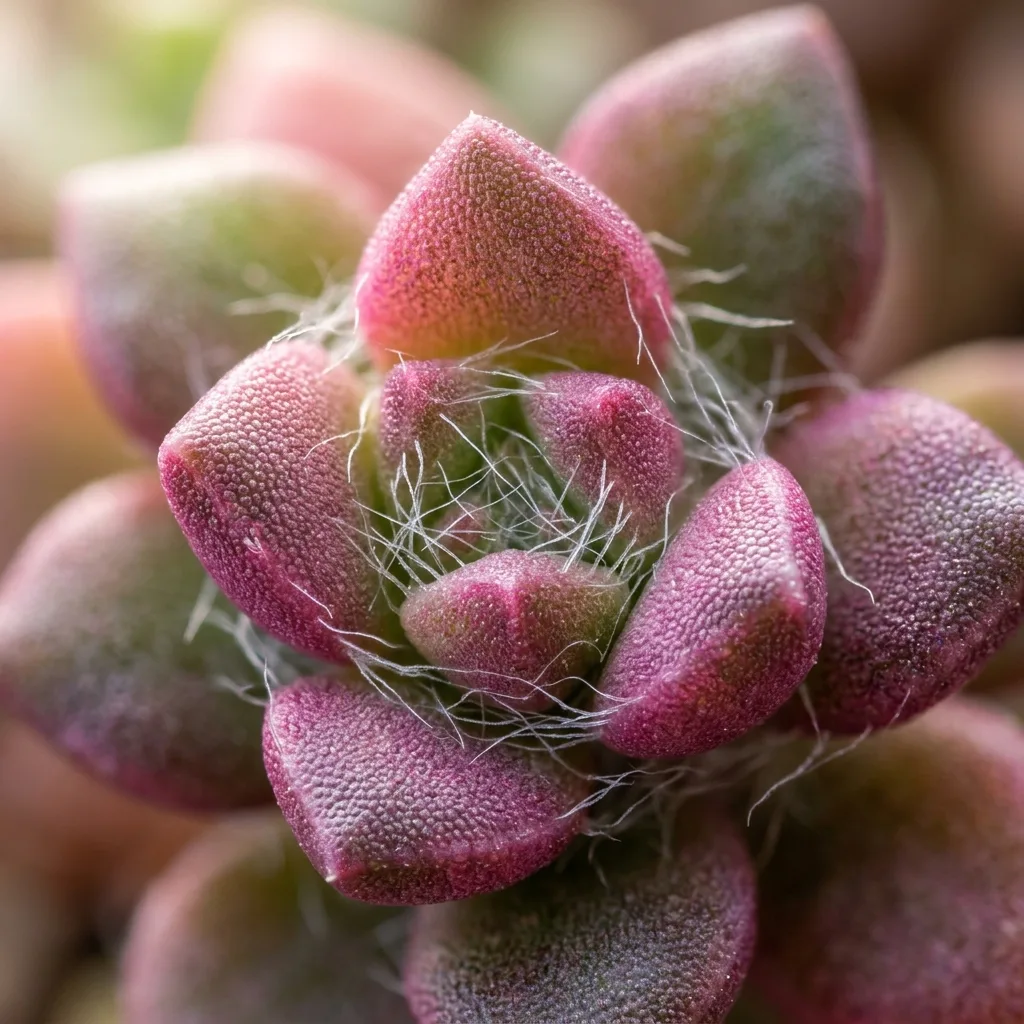
The hallmark morphological feature of this genus is the presence of white, thread-like stipular hairs emerging from the leaf axils. These hair-like structures serve two vital physiological roles. First, they scatter aggressive ultraviolet radiation, functioning as a microclimatic shade screen that protects the delicate leaf mesophyll from photo-oxidation. Second, they capture microscopic dew droplets from nocturnal desert fogs, channeling ambient condensation downward toward the leaf bases and root zone. Stripping, trimming, or cleaning these hairs dismantles the plant's natural cellular armor.
The root architecture of Anacampseros consists of fine, shallow feeder roots adapted to extract ephemeral surface moisture from rocky crevices, anchored by a taproot base that thickens with maturity into a slightly woody, caudex-like crown. Parenchyma cells within the root cortex have an exceptionally high metabolic demand for oxygen. When dense, peat-heavy soils or standing water interrupt gas exchange, the resulting anaerobic environment triggers swift infection by opportunistic oomycetes and fungal pathogens (predominantly Fusarium and Pythium species), dissolving root tissue in mere hours through cellular lysis.
2. Diagnostic Signals and Symptom Identification
Anacampseros exhibits rapid phenotypic responses to shifts in solar radiation, moisture availability, and ambient temperature. Accurate plant diagnostics require deciphering these cellular expressions:
- Dehydration (Water Deficit): The leaves lose their turgid plumpness, feeling pliable to the touch with fine longitudinal wrinkles across the epidermis. This is a natural physiological sign indicating the moisture reserves in the inner parenchyma are depleted and it is safe to irrigate.
- Overwatering and Hypoxia: Foliage turns translucent, yellowed, or jelly-like, detaching from the stem at the slightest touch. A darkened, soft stem base indicates that anaerobic rot has ascended into the xylem vessels.
- Etiolation (Light Starvation): Internodal spacing widens significantly, rosettes lose their compact geometric structure, the plant stretches toward light sources, and magnificent pink or magenta tones fade completely into a dull, washed-out pale green.
- Anthocyanin Synthesis (Beneficial Light Stress): Under 5 to 6 hours of filtered or direct morning sunlight, leaf margins and undersides develop rich magenta, bronze, and violet hues. This signifies optimal protective pigment synthesis and peak photosynthetic vigor.
3. Step-by-Step Cultivation Protocol
Cultivating Anacampseros successfully requires recreating the mineral balance and wet-dry cycles characteristic of its wild, arid habitats:
- Container Selection: Always prioritize unglazed terracotta or ceramic pots with generous drainage holes. The micro-porous walls of unglazed clay facilitate lateral evaporation, preventing localized anaerobic water stagnation. Container depth should be modest—no more than 6 to 8 cm—matching its shallow root profile.
- Base Drainage Layer: Place a 1 cm layer of coarse pumice or volcanic scoria over the drainage hole to ensure water exits unhindered without carrying away your substrate mix.
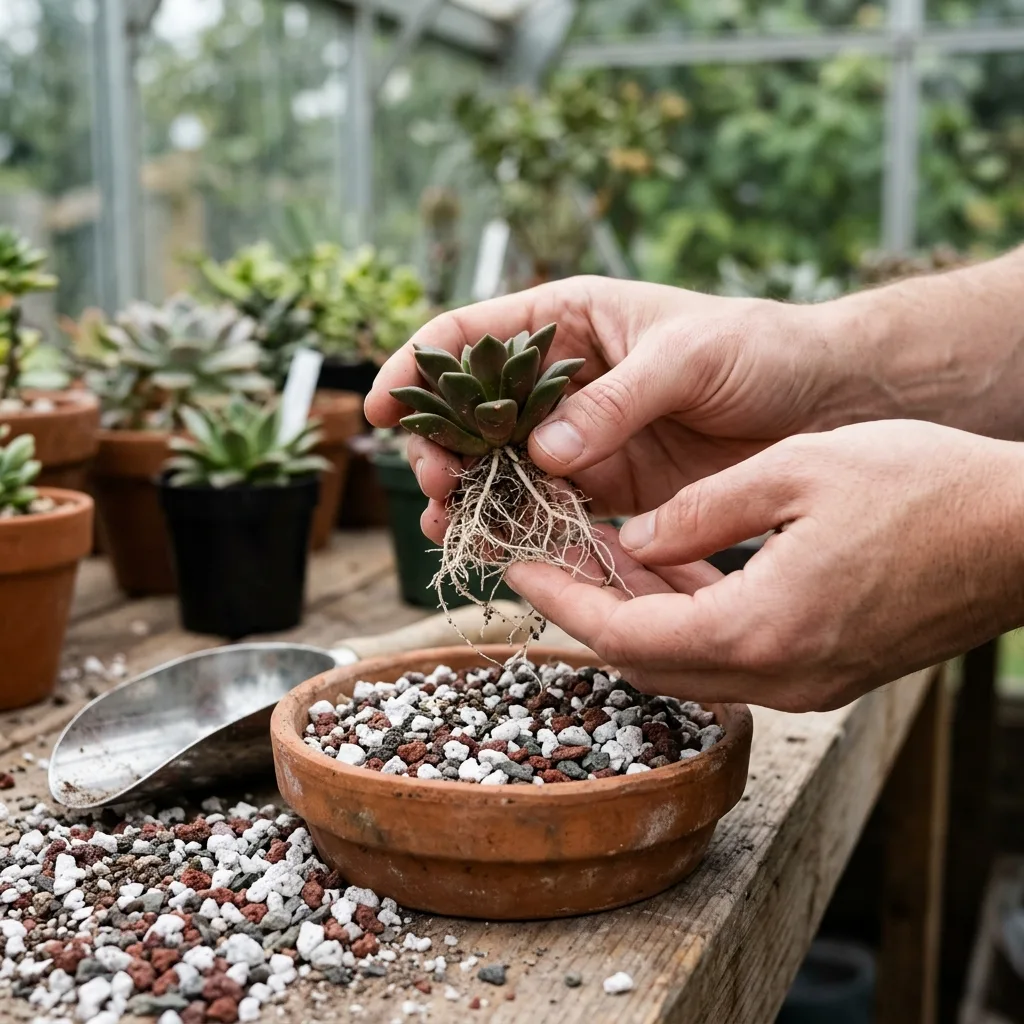
- Planting in a Highly Mineral Substrate: Gently free the roots from nursery peat moss. Center the plant in your grit-dominant substrate so that the root collar sits flush with the final soil line. Never bury the fleshy leaf nodes or crown below the substrate surface.
- Top Dressing: Spread a 0.5 cm protective layer of clean zeolite, coarse silica grit, or fine crushed lava stone across the surface. This separates the basal leaves and axillary stipules from direct soil contact, reducing the incidence of fungal crown decay by roughly 90%.
- Callusing Period: Refrain from watering immediately after repotting. Allow the root system to remain bone-dry for 4 to 5 days so microscopic root lesions can form protective suberized callus tissue.
- The Soak-and-Dry Protocol: Irrigate deeply until water flows freely from the drainage hole. Allow all excess moisture to drain completely, empty the drip tray within 15 minutes, and withhold all water until the substrate has dried out fully from top to bottom.
4. Substrate Composition, Equipment, and Parameters
The optimal substrate for Anacampseros root aeration balances rapid drainage with sufficient cation exchange capacity to deliver trace minerals. Blend the components according to the precise technical ratios below:
| Substrate Component / Metric | Recommended Value | Physiological Function & Purpose |
|---|---|---|
| Coarse Pumice (2–4 mm) | 40% | Maximizes macro-porosity and root zone oxygen diffusion |
| Crushed Volcanic Scoria (2–3 mm) | 20% | Structural integrity, structural aeration, and trace iron delivery |
| Clinoptilolite Zeolite | 15% | Enhances cation-exchange capacity and buffers nutrient salts |
| Sifted Coconut Coir | 25% | Provides minimal organic moisture retention for root anchoring |
| Substrate pH | 6.0–6.8 | Slightly acidic to neutral; optimizes micro-element absorption |
| Luminous Intensity | 15,000–25,000 Lux | Stimulates anthocyanin flush while preventing photo-inhibition |
| Overwintering Temperature | 8°C–12°C (46°F–54°F) | Induces winter rest and supports spring vernalization/flowering |
5. Five Common Mistakes and Recovery Protocols
- Using Off-the-Shelf Potting Soil: Standard potting mixes contain dense peat and vermiculite that stay saturated for weeks, causing root hypoxia. Remedy: Unpot the plant immediately, wash the roots clean, trim any decayed strands, let dry for 24 hours, and transfer into the 75% mineral substrate described above.
- Irrigating During Low-Light Periods: When light levels fall, cellular transpiration drops sharply; water applied during this lull leads directly to root necrosis. Remedy: Move the plant to a brighter southern or eastern exposure and suspend irrigation entirely until visible epidermal creasing returns.
- Treating Natural Trichomes as Pests: Confusing the plant's white axillary stipules with mealybugs and treating with harsh rubbing alcohol or systemic insecticides. Remedy: Cease chemical applications immediately. Mealybugs form sticky, cottony masses accompanied by honeydew, whereas natural stipules are uniform, dry, and attached directly to leaf axils.
- Abrupt Solar Exposure: Relocating a plant from a dim winter spot directly into blistering summer sun causes irreversible white-brown epidermal scorch. Remedy: Acclimatize the plant gradually over 14 days, using sheer shade cloth or introducing it to early-morning sunlight first.
- Watering Through Winter Dormancy: Continued regular watering when temperatures dip below 10°C (50°F) induces rapid basal collapse. Remedy: Withhold water almost completely through winter, offering only a light sip if the foliage becomes severely shriveled.
6. Seasonal Management and Long-Term Care
Synchronizing your care routine with the seasonal rhythms of Anacampseros will reward you with decades of compact, luminous growth:
- Spring (Awakening & Vegetative Surge): As ambient temperatures consistently exceed 15°C (59°F), deliver the season's first thorough, drenching irrigation. Apply a quarter-strength, balanced succulent fertilizer (low in nitrogen, elevated in potassium and phosphorus) every two months.
- Summer (Active Growth & Bloom Cycle): Plants enter their primary reproductive phase. Long, slender scapes emerge bearing fleeting, star-shaped pink blossoms that open for a few hours on warm, sunny afternoons. Water faithfully according to the soak-and-dry cycle.
- Autumn (Pigment Intensification): Sharp temperature differentials between day and night trigger defensive anthocyanin synthesis, deepening foliar hues into rich magenta, burgundy, and bronze. Begin tapering irrigation frequency.
- Winter (Dormancy & Protection): Maintain the plant in a cool, bright, frost-free location (minimum 5°C / 41°F). Keep the substrate thoroughly dry to safeguard cellular integrity.


Reader Reviews & Comments 3 Reviews
Eleanor Vance
Chloe Davenport
Marcus Sterling
Leave a Review & Rating
Share your plant care tips, experiences, or questions with our succulent community.