




A-Z Succulent & Cacti Species Encyclopedia
Detailed botanical ID sheets: light, watering, soil, and pet toxicity.
 🐾 Pet-Safe
Cactaceae
Coahuila Bishop's Cap (Astrophytum coahuilense)
Astrophytum coahuilense is an iconic Chihuahuan Desert cactus that morphologically mimics Astrophytum myriostigma with its spineless, five-ribbed globose form, yet is phylogenetically closer to Astrophytum capricorne. It is distinguished by denser, softer woolly trichomes coating the epidermis and exquisite bright yellow blooms featuring an intense red throat. Highly sought after by specialist growers, this slow-growing succulent requires sharp drainage and bright conditions.
 🐾 Pet-Safe
Crassulaceae
Cobweb Houseleek (Sempervivum arachnoideum)
Native to high-altitude rocky screes across the European Alps and Pyrenees, this mat-forming alpine succulent is renowned for its architectural rosettes. Delicate white trichomes stretch between leaf tips, creating a dense cobweb-like canopy that reflects intense UV radiation and minimizes moisture loss. Individual monocarpic rosettes produce starry pink-red flowers on short cymes before dying, having already established a carpet of stoloniferous offsets.
 🐾 Pet-Safe
Apocynaceae
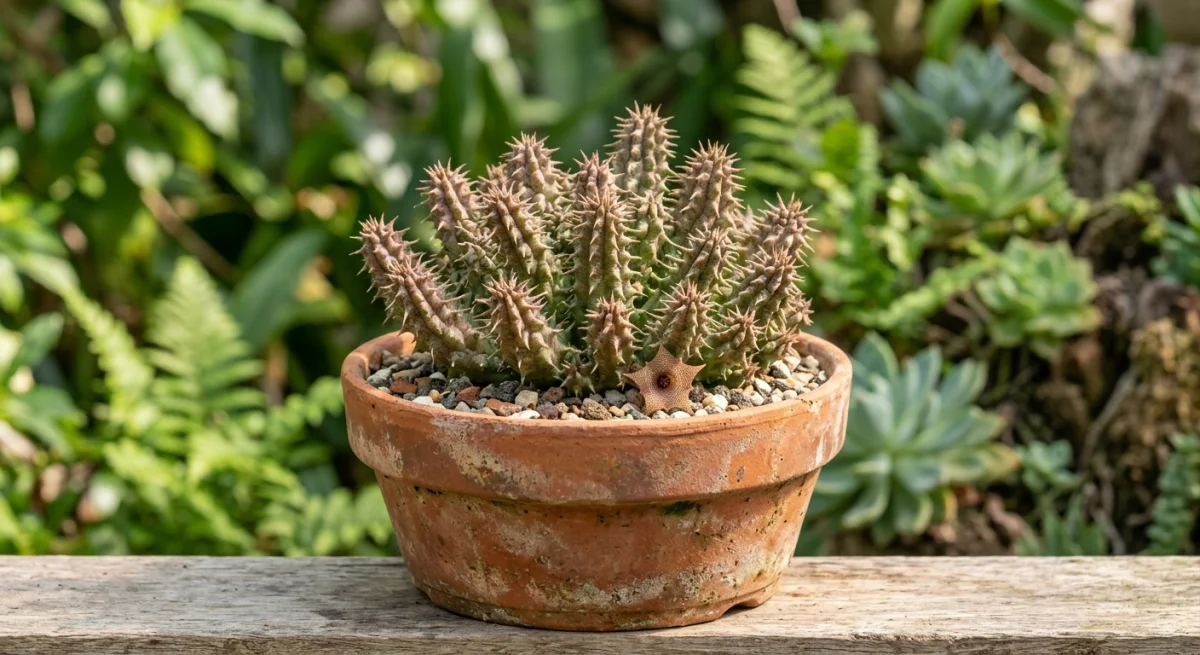
Cocklebur Huernia (Huernia pillansii)
Native to the Little Karoo region of South Africa, Huernia pillansii forms dense clusters of soft, bristle-tipped cylindrical stems reminiscent of sea urchins or cockleburs. In late summer to autumn, it produces captivating star-shaped flowers blanketed in deep red to brownish-maroon papillae over a pale cream base. Its remarkable bristled yet soft texture and dwarf clumping habit make it a centerpiece among succulent collectors.
 🐾 Pet-Safe
Crassulaceae
Colorata Mexican Rosette (Echeveria colorata)
Native to Jalisco, Mexico, Echeveria colorata is a distinguished succulent forming solitary rosettes up to 20-30 cm in diameter with arching, lanceolate leaves coated in a thick, powdery farina. Strong ultraviolet light and cool night temperatures induce dramatic magenta, rose, and deep crimson flushes on the sharp, mucronate leaf tips. It is prized globally by collectors for its architectural symmetry and pristine chalky-blue appearance.
 ⚠️ Toxic to Pets
Crassulaceae
Columnar Crassula (Crassula columella)
Native to the arid, rocky expanses of Namaqualand in South Africa, Crassula columella is an architectural dwarf succulent that forms dense, upright columnar stems covered in tightly packed, velvety leaves. Fine epidermal papillae protect the foliage from intense sun and dehydration, yielding an olive-green to reddish-bronze hue under bright exposure. In late winter or spring, mature columns produce delicate apical clusters of miniature cream-to-yellowish flowers.
 🐾 Pet-Safe
Cactaceae
Comb-spined Mammillaria (Mammillaria pectinifera)
Endemic to the arid highlands of Puebla and Oaxaca in Mexico, Mammillaria pectinifera is a miniature, geophytic cactus possessing a thick, tuberous taproot. Its solitary, flattened-globose stem is densely covered with flat, interlocking white pectinate spines resembling delicate combs flush against the tubercles. In early spring, it produces disproportionately large, diurnal flowers shaded in pale pink to creamy white with darker midstripes.
 🐾 Pet-Safe
Crassulaceae
Common Houseleek / Hens and Chicks (Sempervivum tectorum)
Sempervivum tectorum is a cold-hardy alpine succulent featuring tight, symmetrical rosettes of fleshy green leaves that develop pronounced red-purple tips under strong sunlight. Known familiarly as 'Hens and Chicks', the primary mother rosette spreads vigorously via horizontal stolons to produce dense clusters of clonal offsets. As a monocarpic species, individual rosettes expire after a dramatic summer bloom, leaving behind an established, persistent carpet of younger rosettes.
 🐾 Pet-Safe
Cactaceae
Conical Turk's Cap Cactus (Melocactus conoideus)
Endemic to Bahia, Brazil, this critically endangered cactus is renowned for its dark green, depressed-globose body topped by a dense, conical cephalium bristling with reddish setae and white wool upon reaching maturity. Once the cephalium forms, vegetative stem growth ceases permanently, and apical flowering begins exclusively from this structure. Small magenta blooms are promptly followed by striking, club-shaped bright lilac-pink fruits extruded from the cephalium.
 ⚠️ Toxic to Pets
Crassulaceae
Copper Spoons (Kalanchoe orgyalis)
Native to Madagascar, Kalanchoe orgyalis is a slow-growing, sculptural shrub succulent renowned for its distinct spoon-shaped, concave leaves. The foliage is coated with dense stellate hairs, displaying a striking cinnamon to copper patina on younger leaves that matures into a silvery-gray on the underside. When exposed to bright sunlight, the warm metallic coloration intensifies, crowned in late winter by terminal clusters of bright yellow blossoms.
No succulent or cactus species found matching your criteria.
Try searching with different keywords or reset the filter.


