




A-Z Succulent & Cacti Species Encyclopedia
Detailed botanical ID sheets: light, watering, soil, and pet toxicity.
 🐾 Pet-Safe
Cactaceae
Coquimbo Copiapoa (Copiapoa coquimbana)
Endemic to the coastal desert landscapes of Chile, Copiapoa coquimbana is a clustering cactus that develops large, compact mounds of woolly-topped globose stems over time. It is distinguished by its robust, amber-yellow to dark brown spines and pale yellow, campanulate flowers that crown the apex in spring and summer. Adapted to harsh marine fog (camanchaca) environments, it exemplifies exceptional drought tolerance and architectural beauty.
 ⚠️ Toxic to Pets
Euphorbiaceae
Coral Cactus (Euphorbia lactea 'Cristata')
Not a true cactus, Euphorbia lactea 'Cristata' is a tropical succulent displaying fasciation, a crest mutation that produces undulating, ruffled ridges reminiscent of marine coral. It is most frequently encountered in cultivation as a grafted chimera atop a vigorous Euphorbia neriifolia rootstock. The sculptural crests feature an intricate, pale greyish-green marbling, often edged with striking pink or violet margins.
 🐾 Pet-Safe
Cactaceae
Coral Cactus (Rhipsalis cereuscula)
Rhipsalis cereuscula, commonly known as the coral cactus or rice cactus, is an epiphytic jungle cactus native to Central and South American rainforest canopies. It features slender cylindrical stems densely crowned with clusters of tiny, rice-grain-like branchlets that cascade elegantly over containers. In spring, it produces delicate, bell-shaped creamy-white blossoms followed by translucent, pearl-like berries.
 🐾 Pet-Safe
Crassulaceae
Corsican Stonecrop (Sedum dasyphyllum)
Sedum dasyphyllum is a miniature, mat-forming succulent celebrated for its plump, pebble-like, glaucous blue-gray foliage. Under intense sunlight or temperature swings, the leaves blush with pastel lilac and pink tones, accented by starry white flowers in early summer. Its fragile, bead-like leaves detach effortlessly at the slightest disturbance, readily rooting wherever they land.
 🐾 Pet-Safe
Cactaceae
Creeping Devil Cactus (Stenocereus eruca)
Endemic to Baja California Sur, Stenocereus eruca is an extraordinary prostrate cactus that grows horizontally along the desert floor rather than upright. As the terminal tip roots and creeps forward several centimeters per year, the older rear stem gradually dies and decomposes, giving the illusion of a slowly crawling plant. Its sprawling stems are heavily armed with flattened, dagger-like spines designed to resist extreme desert aridity and herbivores.
 🐾 Pet-Safe
Cactaceae
Crenate Orchid Cactus (Epiphyllum crenatum)
Epiphyllum crenatum is an epiphytic cactus native to the cloud and rainforests of Mexico and Central America, characterized by thick, scalloped (crenate) stem segments. Unlike many nocturnal relatives, it is celebrated for its diurnal, intensely fragrant, creamy-white blooms that can reach up to 20 cm across. As a key parent species of modern hybrid orchid cacti, it offers a stunning pendulous habit ideal for hanging baskets.
 🐾 Pet-Safe
Cactaceae
Crested Wave Cactus (Stenocactus coptonogonus)
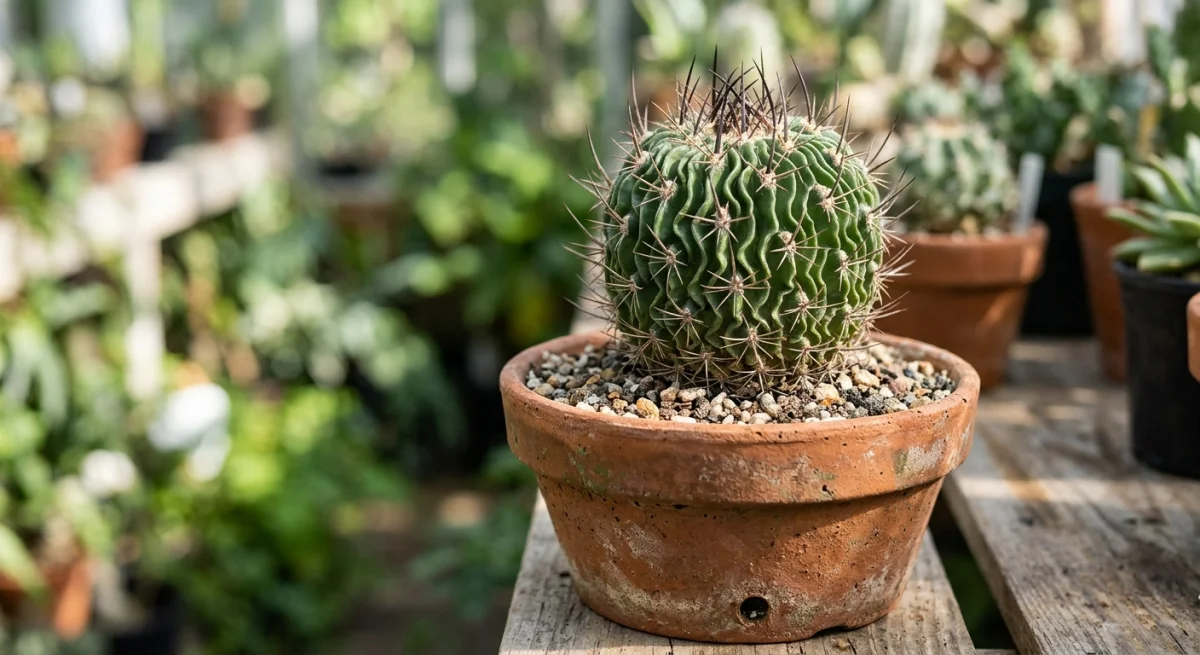
Native to the limestone plains and hills of central Mexico, Stenocactus coptonogonus is an atypical member of its genus, possessing only 10 to 15 thick, triangular, well-defined ribs instead of dozens of thin, paper-like waves. The solitary, depressed-globose stem is armed with stout, upward-curving central spines and produces striking whitish flowers featuring prominent purple or violet midveins.
 🐾 Pet-Safe
Crassulaceae
Crinkle Leaf Plant / Key Lime Pie (Adromischus cristatus)
Native to the Eastern Cape of South Africa, Adromischus cristatus is renowned for its distinctive triangular, plump leaves with crinkled or crested apical margins resembling key lime pie crusts. The compact stems are heavily cloaked in a dense coat of reddish-brown aerial rootlets that provide striking textural contrast. It remains small in stature, making it a prized and durable specimen for windowsill collections.
 ⚠️ Toxic to Pets
Euphorbiaceae
Crown of Thorns (Euphorbia milii)
Native to Madagascar, Euphorbia milii is a resilient, semi-succulent shrub characterized by dense, woody stems armed with prominent sharp spines. It is widely cultivated for its vibrant, petal-like floral bracts that can bloom continuously throughout the year under warm conditions. The plant exudes an irritating, milky white latex sap when damaged, typical of the Euphorbiaceae family.
No succulent or cactus species found matching your criteria.
Try searching with different keywords or reset the filter.


