




A-Z Succulent & Cacti Species Encyclopedia
Detailed botanical ID sheets: light, watering, soil, and pet toxicity.
 🐾 Pet-Safe
Aizoaceae
Fuzzy Button Conophytum (Conophytum stephanii)
Conophytum stephanii is an enchanting miniature mesemb native to South Africa's arid Richtersveld, famous for its tiny button-shaped bodies densely cloaked in bristly white hairs. It is an active winter-grower that produces delicate cream to yellowish flowers in autumn before retreating into a protective dry sheath during its strict summer dormancy.
 🐾 Pet-Safe
Cactaceae
Geometric Ball Cactus (Tephrocactus geometricus)
Native to the high-altitude, hyper-arid regions of Catamarca, Argentina, this extraordinary cactus develops fascinating clusters of near-perfect globular segments. Exposed to intense sun, its epidermis takes on dramatic powdery blue-gray to deep purple hues punctuated by distinct areoles with minimal spines. Highly sought after by collectors, it exemplifies structural succulent perfection and exceptionally slow growth.
 🐾 Pet-Safe
Cactaceae
German Empress Cactus (Disocactus phyllanthoides)
An epiphytic cactus native to the cloud forests of southern Mexico, celebrated for its lanceolate, flattened stem segments and profusion of rose-pink, funnel-shaped blossoms. It exhibits a graceful, pendulous habit ideal for hanging baskets where its vibrant spring floral display can cascade freely. A classic heirloom succulent, it thrives in higher humidity and more filtered conditions than standard desert cacti.
 🐾 Pet-Safe
Crassulaceae
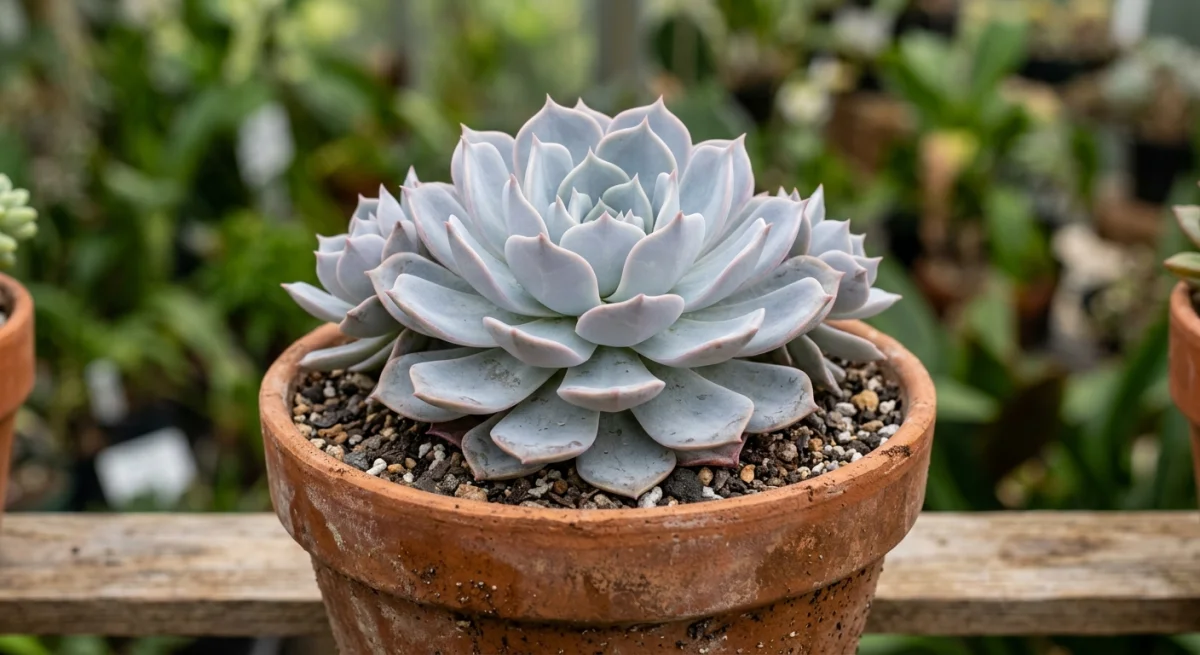
Ghost Echeveria (Echeveria lilacina)
Native to Nuevo León, Mexico, Echeveria lilacina forms a remarkably symmetrical, slow-growing rosette of fleshy, spoon-shaped leaves in ethereal shades of pale silver-grey and delicate lilac. The foliage is enveloped in a dense coating of farina (epicuticular wax), providing a powdery porcelain appearance while deflecting harsh ultraviolet rays. In late winter to spring, mature specimens elevate elegant arching racemes adorned with coral-pink to pale red bell-shaped flowers.
 🐾 Pet-Safe
Crassulaceae
Ghost Plant (Graptopetalum paraguayense)
Native to Mexico, Graptopetalum paraguayense forms sprawling rosettes of thick, succulent leaves coated with a delicate, powdery epicuticular wax that gives them an opalescent grayish-blue to lavender-pink hue. Over time, its creeping to trailing stems spill elegantly over rock gardens and hanging containers, punctuated in spring by small, star-shaped white flowers flecked with red. Renowned for its extreme resilience, it thrives effortlessly under neglected, arid conditions.
 🐾 Pet-Safe
Cactaceae
Giant Barrel Cactus (Echinocactus platyacanthus)
Endemic to the arid plateaus of Mexico, Echinocactus platyacanthus is one of the world's largest barrel cacti, capable of reaching monumental proportions up to 2.5 meters tall. It is readily identified by its dense yellow wool at the apex, prominently ribbed globose-to-columnar stem, and robust, flattened spines. During hot summer months, mature specimens produce brilliant diurnal yellow flowers that crown the apex like a golden tiara.
 🐾 Pet-Safe
Crassulaceae
Giant Chalk Dudleya (Dudleya brittonii)
Native to coastal Baja California, Dudleya brittonii forms striking, solitary rosettes coated in an extraordinarily thick layer of chalky-white epicuticular wax that boasts the highest measured UV reflectivity in the plant kingdom. Reaching up to 45–50 cm across, this species is a winter-grower adapted to Mediterranean climates, entering semi-dormancy during hot summer months. Water should never contact the rosette crown, as it strips the protective farina and invites fatal stem rot.
 🐾 Pet-Safe
Cactaceae
Giant Chin Cactus (Gymnocalycium saglionis)
Native to the arid slopes of northwestern Argentina, Gymnocalycium saglionis is one of the largest species in its genus, forming solitary, massive, depressed-globose stems that can exceed 40 cm in diameter. Its prominent rounded tubercles, reminiscent of 'chins', are crowned with robust, curved yellowish-to-reddish spines that wrap protectively around the plant. In late spring and summer, it produces short-tubed, waxy white-to-pale-pink flowers nestled atop the apex, followed by spherical reddish fruits.
 🐾 Pet-Safe
Crassulaceae
Giant Hen and Chicks (Echeveria gibbiflora)
Native to Mexico, Echeveria gibbiflora is a monumental succulent producing solitary rosettes up to 40 cm in diameter with broad, spoon-shaped, glaucous-blue to purplish leaves. Serving as the primary genetic ancestor to countless beloved cultivars (including 'Perle von Nürnberg'), it is protected by a delicate farina wax coating that imparts a soft frosted finish. In late autumn and winter, it bears tall inflorescences adorned with vivid reddish-orange, bell-shaped blossoms.
No succulent or cactus species found matching your criteria.
Try searching with different keywords or reset the filter.


